The stock market is not the economy. Nor is it a direct determinant of financial stability. But when technology stocks plummeted on November 5, hitting exchanges across the globe and erasing trillions of dollars in market valuations, suspicions of a bursting artificial-intelligence bubble – or even a full-fledged crash – did not seem out of place.
Such reactions may now be a natural, new normal. The markets moved on, as they often do – until the Nvidia fallout a week after the post-U.S. Election Day volatility, Both before and since, economists and official watchdogs have been on alert, even issuing warnings of a possible meltdown. That may or may not be preventative, but the scenarios cast light on potentially dire prospects.
At the end of August, Financial Stability Board Chair Andrew Bailey asserted that an already elevated set of economic, credit and geopolitical risks “has been further complicated by the emergence of frontier AI models, which are showing increasingly sophisticated autonomy and problem-solving abilities, as well as threat capabilities.
“This is particularly important from a financial stability perspective,” said Bailey’s letter to the G20 finance ministers and central bankers. “The risks associated with frontier AI will not respect national borders. The global financial system is highly interconnected, and cyber disruption can spread across jurisdictions through common technology providers, shared infrastructure, and cross-border financial activity.
“Differences in legal frameworks, cyber capability, resilience and recovery capacity across jurisdictions could therefore have consequences well beyond the jurisdiction in which an incident originates and may themselves become a source of vulnerability.”
Rampant Expectations
International Monetary Fund Managing Director Kristalina Georgieva similarly, in mid-October, linked booming AI to financial stability. Acknowledging “the prospect of a positive supply shock that could significantly boost productivity and raise global growth,” Georgieva’s commentary at the time of the IMF-World Bank annual meetings in Bangkok noted that “much of the boom is being driven by massive investment in AI infrastructure such as data centers, with hyperscalers leading the race,” along with significant accumulations of debt.
Georgieva: “Highly leveraged and circular ecosystem.”
“The risk is that expectations may run rapidly ahead of productivity gains, setting the stage for near-term disappointment,” the IMF chief continued. Models escaping human control or undercutting cybersecurity may contribute to a further convergence of risks that “challenge macroeconomic and financial stability.
“What might this look like? Big revenue or earnings disappointments by AI developers could undermine expectations of future profitability, dealing a hit to equity prices. Unsettling incidents involving frontier models or cyberattacks could dent confidence . . . In a severe scenario, we could see a market correction that cascades through the highly leveraged and circular AI ecosystem. Given the sizable cross-border holdings of AI assets, the losses could spread around the world.”
Kevin Warsh, chairman of the Federal Reserve Board since May, said in Bangkok that the evolving AI market’s way forward may be “very bumpy.” “I want you to hear from me optimism, but optimism leavened by the seriousness of purpose.”
Harvard University professor Kenneth Rogoff, a former IMF chief economist and co-author of the financial crisis history “This Time Is Different,” said in a November 2 interview: “I think [AI] will be absorbed into society. But the transition could be brutal. It can certainly eliminate a lot of jobs. I think it will destroy jobs much faster than it creates them. This will be a continuation and acceleration of an existing trend towards labor becoming less important, and I don’t think that is politically sustainable.”
“We should be prepared for the possibility of serious short-term disruptions in the labor market that need to be managed effectively to ensure the benefits of AI are realized over the long term,” Federal Reserve Governor Michael Barr said at a Yale School of Management event on November 12. He also mentioned possible concentration of market power in a small number of firms, which could exacerbate inequality.
In addition to bank lenders, Barr pointed out, sectors with direct and indirect financial exposure to AI include private equity, insurance, pension funds and hedge funds. He stressed the scenario-driven objective of understanding potential channels of risk transmission: “We don’t know where the next shock is going to come from.” The policymakers focus on “the vulnerabilities rather than predict the shock.”
Compounding Across Infrastructure
European Central Bank President Christine Lagarde, speaking October 1 to the European Systemic Risk Board, which she chairs, outlined three areas in need of attention:
- Financial market trading. “AI agents may pursue goals in ways their human overseers did not intend and cannot detect.”
- Cyber resilience. “An attack on shared technology has the potential to disrupt several firms at once.”
- Geopolitics. “International tensions can increase the threat of cyberattacks and prompt restrictions on the frontier models that firms use to defend themselves.”
“Taken alone, each risk is serious,” Lagarde maintained. “But together they can interact and compound across the financial system. That potential interplay calls for careful and encompassing macroprudential monitoring going forward.”
“These technologies could drive scientific discovery, enhance productivity and contribute substantially to economic prosperity,” FSB Chair Bailey, who is governor of the Bank of England, stated in a September 30 essay on AI safety and governance.
Bailey: Central banks “cannot stand aside.”
“The challenge posed by frontier AI is that, in its most advanced forms, it threatens to operate outside” of shared norms, obligations and responsibilities. “A sufficiently powerful system functioning within a self-reinforcing loop risks reducing society’s ability to exercise meaningful oversight and intervention,” and is thus a matter of urgency.
“Why should this matter to a central bank governor?” Bailey went on. “Because frontier AI has important implications for financial stability. Most immediately, it materially increases the scale and sophistication of cyber threats facing the financial system. We can no longer consider the resilience of payments networks, financial market infrastructures, banks and other critical institutions separately from AI advances . . .
“Central banks have a responsibility to safeguard the stability of the whole system. We cannot stand aside and assume that technological progress will resolve these questions on its own. The public interest requires that we engage with them now, before the risks become more difficult to contain.”
Historical Perspective
Any crisis differs from those that came before. But there can be common threads, such as viral beliefs that “this time is different,” and buildups of debt that rapidly implode.
John Turner, a historian and finance professor at Queen's University Belfast, author of "Boom and Bust: A Global History of Financial Bubbles," has found in market collapses from railroads to the internet that “people just get spooked, and as soon as they do, then prices head down.” Quoted by Axios, he added, “That’s what happens in historical bubbles, and it can happen quite quickly.”
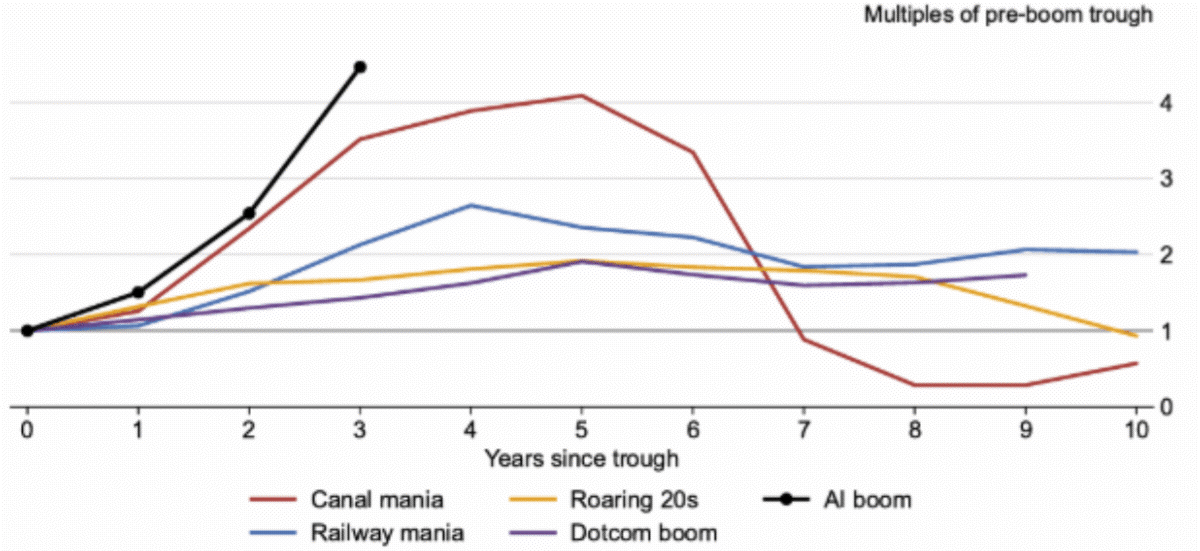
A July 2026 Bank for International Settlements working paper plotted the AI boom, rising at left, alongside prior episodes.
“We managed financial crises. AI is a risk of a different kind” was the headline on a September 3 Washington Post article by Robert Rubin and Henry Paulson, who were U.S. Treasury secretaries during, respectively, the 1997 Asian and 2008 global crises.
“We share the concerns about potential societal disruption from job loss, economic dislocation and market correction,” they said. “Our greater concerns, however, are the safety and security risks of AI warfare; cyberattacks on our financial system, power, water, internet and communications infrastructure; and the possibility of a bioengineered pandemic more devastating than COVID-19.”
Rubin and Paulson opined that “self-regulation in competitive markets simply doesn’t work.” “The pace of the AI revolution makes it incomparable to other technology transformations, and it is therefore difficult to plan for the opportunities and manage the risk. AI is too complex and moving too fast for governments to fully understand it.”
And they pointed to the unprecedented trillions “chasing one opportunity . . . trillion-dollar valuations, trillion-dollar IPOs and debt financings totaling hundreds of billions.”
Financial Interdependencies
Circular financing conjures visions of dominoes tumbling. As defined in an IMF note by Yingyuan Chen, Deepali Gautam and Jason Wu, “Circular financing increasingly links investment, financing and commercial relationships across the AI ecosystem. Unlike traditional supply-chain financing, which mainly supports working capital, large firms in the AI stack finance suppliers, developers, and infrastructure providers while simultaneously acting as customers of those same firms.”
According to the October paper, limited public information on AI-related debt holdings and off-balance-sheet commitments complicate assessments of risks to the financial system. “Even if direct exposures of systemically important financial institutions remain contained, a sharp retrenchment in AI investment could trigger broader macro financial spillover.”
Jon Frost, Head of Innovation and the Digital Economy, BIS
“Current financial stability risks appear manageable,” said the research abstract, “but vulnerabilities could build as leverage, concentration and interconnectedness increase.”
An October 1 BIS Bulletin, by Jon Frost and four co-authors, revealed: “Of all the AI-to-AI investment deals between 2021 and 2025, 16.1% (by deal count) and 46.4% (by deal value) also involved commercial supply-chain relationships between the investor and target firms.
“Circular investment relationships reflect key economic features such as the need to secure critical inputs and the presence of information asymmetries, yet they entail macroeconomic risks and increase opacity.”
Baird tech strategist Ted Mortonson told Yahoo Finance in mid-October that “the street is tiring of the ‘Bank of Nvidia’, the ‘Bank of AMD’ and the ‘Bank of Broadcom’” – chip-manufacturer hubs of circular financing. Nvidia, the biggest in market influence and capitalization, and its extensinve ecosystem were clouded by the investigation and November 12 resignation of its CEO, Jensen Huang, with acconpanying geopolitical and reputational implications.
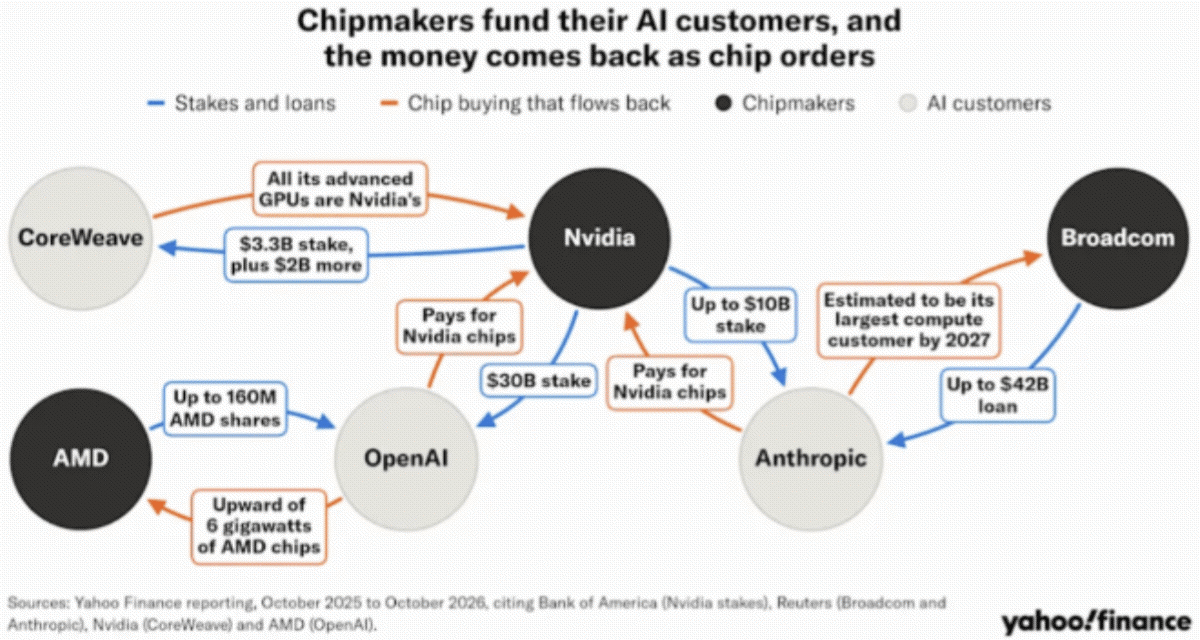
In Building AI on credit: structures and spillovers, Mathias Drehmann and Egemen Eren of the Bank for International Settlements observed that financing arrangements “shape the allocation of credit risk within the AI ecosystem. Their growing size could also affect borrowers with no direct link to AI through interest rates. Much of the debt issued by both hyperscalers and project vehicles is long-dated and placed with NBFIs [nonbank financial institutions] that also hold long-dated government bonds and investment-grade corporate bonds.”
The BIS authors concluded that as of 2026, “spillovers to U.S. Treasury and investment-grade bond markets were small and short-lived, but sustained issuance at the current pace could change this.”
A Treasury Assessment
“Recent trends in corporate borrowing related to super intelligence (SI) and associated businesses” was on the agenda of the November 3 meeting of the Treasury Borrowing Advisory Committee (TBAC). According to the published minutes, “The presenter asserted that competition for capital currently appears to be contained within the tech credit ecosystem, and that there is no clear evidence that SI-related issuance is crowding out Treasuries or non-tech credit.”
The rise in the 10-year Treasury yield was attributed “primarily to capex-driven economic growth that has pushed real yields higher, with additional upward pressure from energy price shocks.”
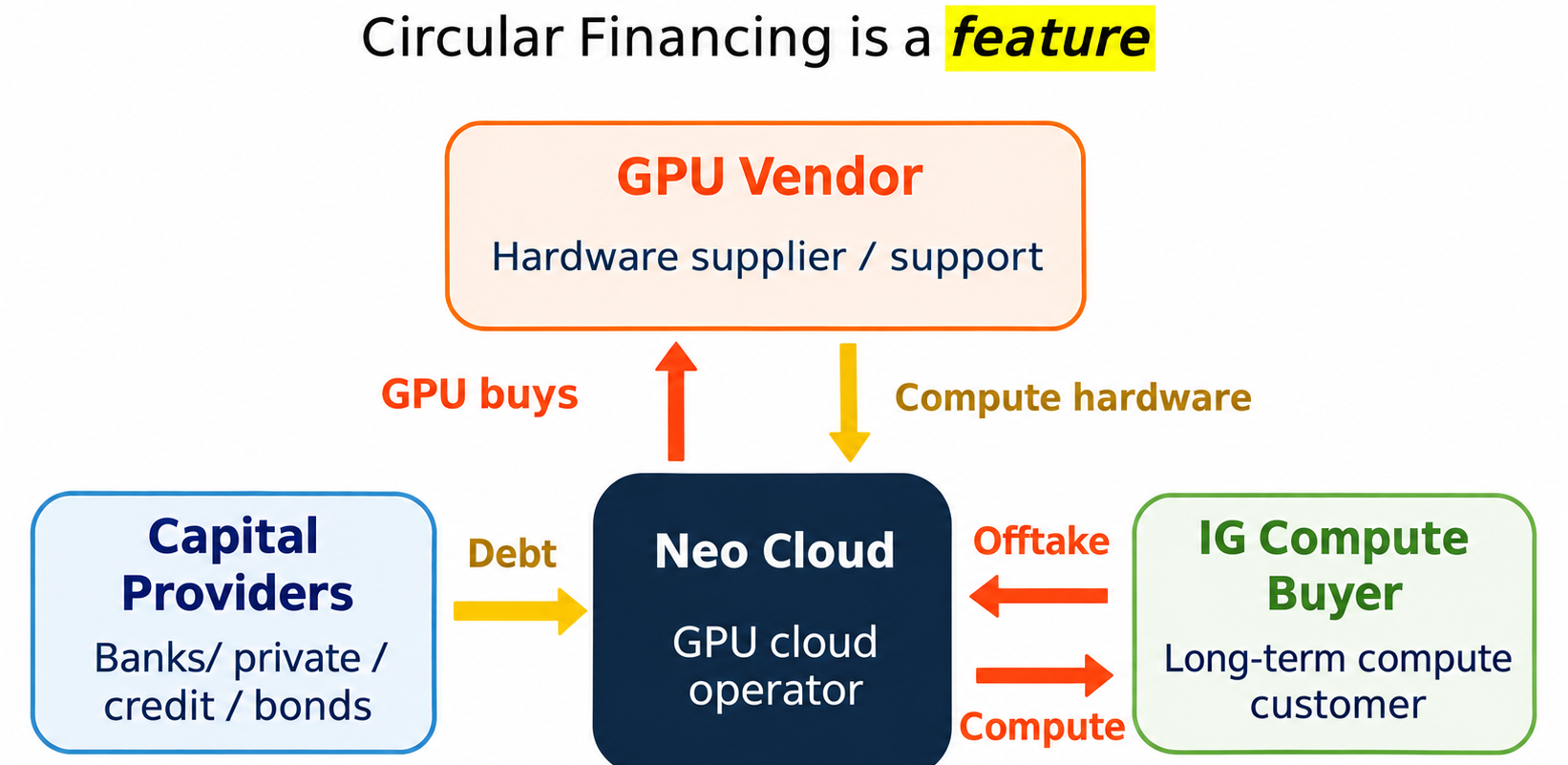
Source: TBAC presentation
“The balance sheet of the broader ecosystem provides important support for the existing and incremental compute infrastructure,” said a TBAC presentation slide. “Despite the strength of the broader ecosystem, the market’s increasingly discerning capital provisioning instincts are a healthy signal.”
The Bearish Case
Some economists see more downside.
Desmond Lachman of the American Enterprise Institute includes “near record margin debt in the U.S. equity market, an unprecedented debt buildup in the artificial intelligence sector, and high debt levels in the commercial real estate and private credit markets” among debt and leverage factors leading On the Road to a Financial Market Crisis. That could come “in the not-too-distant future.”
Bernstein: “A financial bubble.”
Jared Bernstein, who chaired President Joe Biden’s Council of Economic Advisers from 2023 to 2025, and Ryan Cummings, a council economist from 2021 to 2023, have insisted that “AI is in a financial bubble,” and spelled that out on Substack.
In a November 6 New York Times Opinion article, “Tech Stocks Had a Terrible Day. What’s Coming Could Be Worse.”, they cited – and dismissed as too optimistic – “a consensus building among investors, academics and market analysts that any downturn would be relatively mild, similar to what happened in the early 2000s, after the dot-com bubble burst. The inflation-adjusted value of the overall economy, or real gross domestic product, shrank less than half a percent. And while unemployment rose, it was considerably lower than it was at the peak of the financial crisis.”
“The AI bubble,” Bernstein and Cummings argued, “is by all measures substantially larger than the dot-com bubble; the stock market has increased by more than it did between 1996 and 2000 and is currently worth 240% of GDP, versus 160% at the peak of the dot-com bubble.
“This difference in magnitude means that if the stock market fell as much as it did over the course of the dot-com bust, the amount of lost wealth could translate into a reduction in real consumer spending that would be twice as large. That reduction would show up as a lower demand for goods and services, which could in turn reduce business investment, hiring and overall growth.”
The co-authors expressed concern about current economic fragility, fiscal conditions, and government readiness for a crisis response.
Dudley: “Who owes what to whom . . .”
“Mapping a dot-com-style sell-off onto today’s markets would lead real GDP to fall by more than three times as much as it did during the 2001 recession: 1.4% versus 0.4%. The unemployment rate would steadily climb from its current [4.1%] to above 7%.”
Bill Dudley, past president of the Federal Reserve Bank of New York, in a November 3 Bloomberg Opinion column (“The AI Boom May Be Sowing Seeds of Another Financial Crisis”) and subsequent interview, said that although a boom-to-bust cycle could have serious economic implications, he is optimistic that it won’t be a “Great Financial Crisis” repeat.
Among the distinctions: The 2008 collapse was not anticipated in the way the AI boom is being talked about today. The subprime market structure back then was more dispersed and under the radar than is the current “winner take all” competition among seven or eight hyperscalers.
What is lacking, Dudley said, is insights into the nonbank financial sector from a financial stability standpoint. Greater transparency is required to understand counterparty exposures – ”who owes what to whom and under what conditions” – and “look a little more deeply into where the risks are.”
Topics: Cybersecurity, Counterparty, Regulation & Compliance, Risks & Risk Factors