
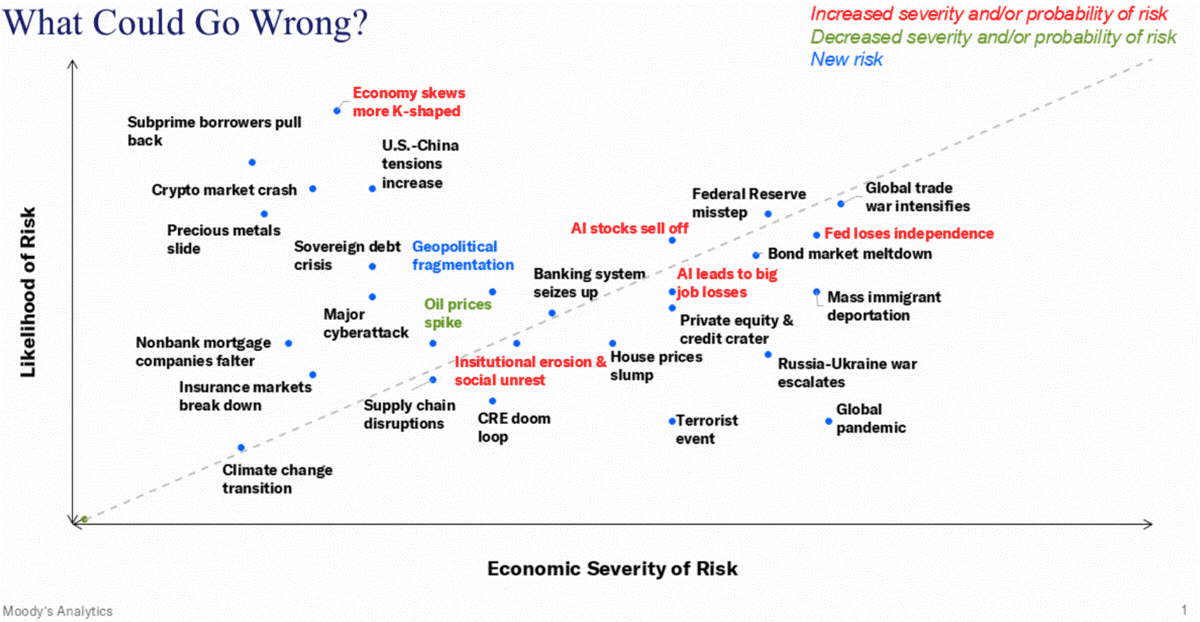
Risk managers enter 2026 facing an unusually complex landscape marked by multiple structural shifts, including rapid technological advancements, significant demographic shifts, and record levels of government debt. While the number of challenges facing the economy in the latest Moody’s Analytics macroeconomic risk matrix is daunting, five risks stand out for their potential to disrupt business operations, strain finances, and companies to fundamentally rethink how they manage uncertainty in 2026.
Here, we examine these critical risks and outline the steps risk managers should take to prevent and mitigate their impact.
1. When Monetary Policy Loses Its Power
The Federal Reserve is trying to thread a needle that keeps getting smaller. Raising interest rates or keeping them elevated for too long could lead companies to lay off workers as credit costs pinch budgets, aggregate demand falls, and the economy slides towards recession.
Cut rates too quickly, and inflation may come roaring back, eroding household purchasing power. The lock-in effect of long-dated mortgages and corporate debt further complicates the Fed’s decision, as the economy is less interest rate sensitive than in the past.
Trade policy remains an underappreciated inflation risk as we head into 2026. Tariff negotiations, including the USMCA, and potential policy shifts could reignite price pressures precisely when the Fed hopes inflation is contained. If this materializes, the Fed may face a Volcker-era dilemma where it prioritizes inflation control by keeping rates elevated even as the labor market weakens, accepting the recessionary consequences necessary to break inflation's grip. With structural price pressures persisting in housing, insurance, and services, this painful choice may be unavoidable. Potential external political pressure to keep interest rates low – or lower them further – could further complicate the Fed’s decision and increase the chances of a misstep.
Why this matters: This uncertainty poses a direct threat to financial stability. A bank planning for more Fed rate cuts might welcome a steepening of the yield curve and assume struggling commercial real estate loans will refinance more easily in 2026. However, if rates stay high, CRE loans – including those backed by half-empty office towers that were financed at peak prices – won’t be able to refinance. Lenders may face unexpected losses.
Or, consider the homeowner or manufacturing company that borrowed heavily in recent years, expecting cheaper refinancing in 2026. If that doesn’t materialize, homeowners may struggle with monthly payments as income growth slows with the labor market. Companies may need to cut investments and hiring, with negative consequences for suppliers, lenders, and local communities.
What risk managers should watch: The economy has become more dependent on wealthy households for spending, and on AI companies for investment. With substantial assets tied up in equities, wealthier households are particularly sensitive to stock market volatility. If inflation forces the Fed to keep interest rates high – or a policy mistake triggers a market correction – consumer spending could drop more sharply than historical patterns suggest, catching retailers and consumer-facing businesses off guard.
2. When Demographics and AI Collide
Imagine a hospital where experienced nurses are retiring faster than new ones can be trained, while at the same time, artificial intelligence is eliminating jobs for medical billing specialists and administrative staff.
Cristian deRitis
This is the paradox hitting companies across industries in 2026.
Every day throughout 2026, over 11,000 baby boomers will turn 65. Many possess institutional knowledge. It might be the engineer who understands the quirks of a 30-year-old manufacturing system, the credit officer who remembers why certain loan exceptions were made, or the accountant versed in loan-loss accounting methods.
Simultaneously, AI is eliminating – or threatening to eliminate – entire categories of work, including legal research assistants, customer service representatives, data entry clerks, and junior software engineers. But AI may not be able to replace the deep knowledge of retiring experts. Moreover, eliminating entry-level positions today could lead to a shortage of middle and senior managers in 10 years. This creates a conundrum for managers and boards, as improved productivity may enhance profitability in the short term while posing an operational risk in the long term.
Why this matters: The dynamic could create wage compensation pressures. Regional banks might need to offer 10% annual raises to retain experienced lending officers while simultaneously cutting hundreds of back-office jobs and freezing the number of junior analysts. Manufacturers may face similar whiplash as they compete aggressively for skilled technicians who can work with AI while also eliminating manual quality control inspections.
What risk managers should watch: Knowledge loss can quickly turn into an operational risk. When the one person who understands a critical system retires, things may break with little recourse. Meanwhile, some AI systems deployed hastily in the recent rush to automate may show their limitations. Unsupervised systems may make incorrect production or lending decisions, miss important nuances or suspicious activity, or fail spectacularly in unusual situations that an experienced human would flag.
Scenario planning is more important than ever. What happens if wages for critical roles inflate 10% to 15% annually for five years with no pipeline of future middle managers? What if laid-off workers need to be recalled because AI cannot handle unforeseen exceptions? What if AI not only displaces the jobs within a company but also those of its customers?
3. When Private Credit Faces Its First Real Stress Test
Private credit has quietly grown outside of traditional banking over the past decade. Flying under the regulatory radar, these investment funds now hold an estimated $2 trillion to $3 trillion globally in loans to borrowers spanning tech companies, retail chains, healthcare providers, and manufacturers.
The value proposition presented to investors is compelling: In exchange for sacrificing the liquidity of public markets, investors get higher returns plus inflation protection through floating rates, all backed by robust covenants.
However, the reality of the marketplace has diverged from this promise. As the volume of private capital seeking deployment has surged, competition among funds has intensified. Borrowers may be offered more lenient loan terms based on optimistic projections regarding their ability to repay or refinance their obligations. The rush to deploy capital has eroded the strong lender protections that justified the strategy in some instances.
In 2026, if a company that financed through private credit begins to experience a sharp downturn in performance, driven by broader economic weakening or the withdrawal of key support, its ability to meet its obligations could falter. Should that happen, conditions may deteriorate quickly. Unlike traditional bank loans, which have clear workout processes, private credit deals often involve competing lenders, unclear rules, and a lack of established protocols. Recovery rates may fall significantly below initial expectations.
Why this matters: Contagion would be a significant risk in this scenario. Nervous investors may start questioning the value and recoverability of other private credit loans – even those at low risk of default. Some investors may want to withdraw their funds, but there is no easy way to sell these loans. Some funds could be forced to freeze withdrawals, creating a panic.
What risk managers should watch: Banks that lent money to private credit funds or business development corporations could face significant exposure. Insurance companies and pension funds with large allocations to private credit may need to reassess the conditions under which they can recoup their investments. Companies that financed their operations with private credit should develop contingency plans in case financing dries up.
4. When Insurance Markets Withdraw
Property insurance has become increasingly expensive and difficult to obtain. Purchasing homeowners insurance in coastal Florida or California wildfire zones has become impossible or prohibitively expensive for many. The issue is no longer limited to traditionally high-risk locations. Insurance availability and affordability challenges now affect homeowners and businesses across regions, as storms and floods increasingly impact areas once considered relatively safe.
Why this matters: Beyond rising costs, the lack of availability can have serious knock-on effects. A real estate investor may be unable to close on a commercial property without insurance at any reasonable price. A manufacturer may not expand to a new location because property coverage does not exist. A city may have to scale back services because liability insurance is unaffordable.
The issue extends beyond property and casualty insurance, with cyber insurance adding exclusions and requiring specific security controls, given the rise of AI-driven threats.
What risk managers should watch: Companies may be forced to retain risks that they don’t want to, essentially self-insuring out of necessity rather than choice. A catastrophic loss previously covered by insurance may now become a direct hit to earnings or capital. Business strategies and opportunities may be constrained as companies cannot expand if they cannot insure their operations.
Organizations will need to initiate difficult discussions with senior executives and boards. Companies will need to reassess current risk management strategies and prepare for scenarios where insurance becomes prohibitively expensive or unavailable. By planning ahead, they can identify alternative risk mitigation strategies, plan for self-insurance if needed, and ensure that business operations remain resilient despite insurance market disruptions.
5. When AI Security Gaps Get Exploited
In their rush to implement artificial intelligence solutions, some companies prioritized rapid deployment over careful risk assessment and governance. This haste could expose serious vulnerabilities in 2026.
Why this matters: Consider criminals leveraging deepfake technology to impersonate executives during video conferences, convincingly authorizing an action such as a wire transfer. Traditional voice and video verification methods no longer provide reliable safeguards against sophisticated deception.
Or, a financial institution may discover that AI-powered fraudsters generated thousands of fake identities, complete with fabricated credit histories, that bypassed automated approval systems designed to streamline account openings. Criminals may collect sign-up bonuses or accumulate substantial credit balances, causing significant financial losses.
At a macro level, a cyberattack might target a port or utility, not just stealing data but also shutting down physical operations by exploiting weaknesses in AI-powered security systems. The impact would go beyond an individual company to affect an entire region or industry.
What risk managers should watch: Companies that deployed AI quickly may need to retrofit the controls and governance they should have built from the start. This involves ensuring human oversight, understanding potential risks, and establishing clear accountability and remediation procedures.
Parting Thoughts: It’s All Connected
As the past three decades have taught us, risks don’t happen in isolation. A Fed policy mistake could trigger stress in private credit markets. Insurance becoming unavailable may force companies to retain more risk, just as cyber threats intensify. Job elimination due to AI may create operational vulnerabilities that could be exploited by fraud or cyberattacks.
Risk managers in 2026 will need to address not only individual risks but also recognize how they interconnect and amplify each other. These overlapping challenges will require a comprehensive approach to risk management that considers the compounding effect of multiple threats occurring simultaneously.
The organizations best positioned to navigate the challenges ahead will be those that actively identify and analyze these interconnections. By stress-testing scenarios that account for overlapping risks, they gain a better understanding of how one event may trigger or exacerbate another. Equally important is fostering transparent, ongoing discussions with leadership teams. Through this integrated approach, businesses will be better prepared to respond effectively to the complex risk environment that lies ahead in 2026.
Cristian deRitis is Managing Director and Deputy Chief Economist at Moody's Analytics. As the head of econometric model research and development, he specializes in analyzing current and future economic conditions, scenario design, consumer credit markets, and housing. In addition to his published research, Cristian is a co-host of the popular Inside Economics Podcast. He can be reached at cristian.deritis@moodys.com.
Topics: Default, Enterprise, Financial Markets, Resilience