
There comes a point in the life of every risk manager when they learn that tail events matter much more than averages. But what happens when the preference for tail events and long-shot bets migrates from the casino floor to a lender’s credit portfolio, a retail brokerage, and a consumer’s balance sheet?
Call it the lottery ticket economy.
A growing body of behavioral and economic evidence suggests that lottery-style thinking – or the belief that a single asymmetric bet can leapfrog years of disciplined saving – is no longer restricted to state-run games of chance. It’s now a key driver behind the growth in online gambling, cryptocurrency speculation, and retail investment in momentum-driven AI stocks.
For risk managers, the implications of the lottery ticket economy extend well beyond consumer protection. This behavioral shift is affecting credit quality, market volatility, and systemic fragility in ways that warrant serious analytical attention.
Not New, but Bigger and More Accessible
Behavioral economists have long documented the cognitive biases underlying lottery participation, including optimism bias, the illusion of control, and hyperbolic discounting. These are not exotic pathologies that afflict a small minority. Rather, they are features of normal human cognition that may intensify under conditions of economic stress or diminished opportunity. Wishful thinking is a tale as old as time.
Cristian deRitis: New behavioral reality.
What is new is the convergence of three forces that are supercharging these tendencies across broad swaths of the population.
First, digital platforms have radically lowered the frictions around speculative behavior. The same smartphone that delivers an online gambling account parlay can also open a stock options screen, a cryptocurrency account, and any number of prediction markets. These platforms leverage video game design to deliberately engineer for engagement, including variable reward schedules, push notifications, and social leaderboards. What may be a playful, occasional pastime for some can turn into a serious addiction for others.
Second, the deterioration in traditional pathways to wealth-building has made lottery-ticket thinking feel rational rather than reckless. Homeownership rates among young adults remain below pre-financial-crisis norms given affordability challenges. Real wage growth has been anemic – especially for non-college graduates. And while college graduates may earn higher salaries – provided they can find a job – rising student debt has lengthened the timeline to financial independence by years. When saving feels futile, speculation may feel like the only game in town.
Third, the regulatory lines separating “gambling” from “investing” have blurred. By 2025, 38 states had legalized wagering, generating a record $78.7 billion in commercial gaming revenue, per the AGA Commercial Gaming Revenue Tracker. More consequentially, a 2024 federal court ruling overturned the Commodity Futures Trading Commission’s attempt to block prediction markets. Along with the new administration's decision to drop the CFTC’s appeal in 2025, event-based wagering was formally embedded into the derivatives market.
Gambling platforms now partner with other market makers to offer retail contracts on S&P 500 levels and GDP forecasts. The user placing a parlay bet on Sunday and trading a zero-days-to-expiration (0DTE) equity option on Monday is engaged in fundamentally identical behavior. And increasingly, it’s the same user on the same platform.
What the Data Tell Us
The numbers are striking. According to the TransUnion 2025 Betting Report, 30% of U.S. consumers participated in betting in Q2 2025, up from 25% a year earlier. Betting participation reached 34% among Gen Z and 42% among Millennials. These are not fringe cohorts but primary consumers who will – or should – drive the economy over the next decade.
More telling than the participation rates is the overlap across activities. High-frequency gamblers disproportionately coincide with heavy users of mobile trading apps and crypto. Moreover, an Intuit Credit Karma study found that 37% of Gen Z sports bettors self-identified as addicted – 14 percentage points above the all-ages average – and 22% of bettors overall reported financial hardship and emotional distress for themselves and their families that is directly attributable to betting.
In the stock market, 0DTE options have grown more than fivefold over the past three years on the S&P 500 alone, with retail traders accounting for 50-60% of that activity, according to the CBOE. These financial instruments provide a defined upside for a small upfront premium but expire worthless most of the time. In economic terms, that’s just a lottery ticket with better marketing.
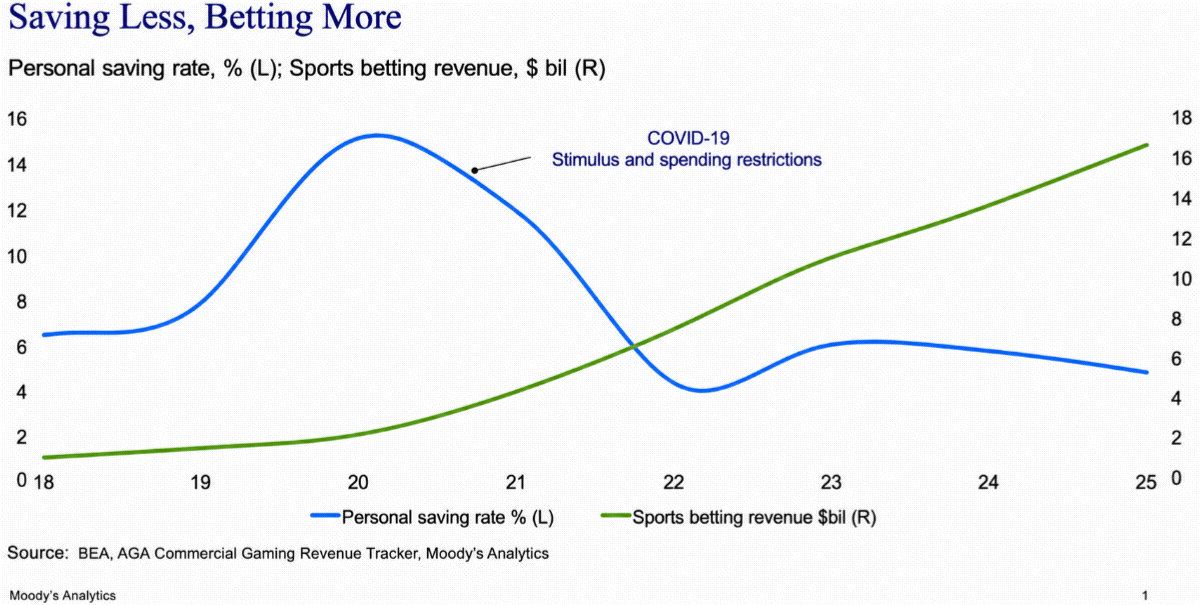
The personal savings rate tells the broader story, having fallen to 3.6% in the first quarter of 2026 from a post-2000 average of 5.6%. Household financial buffers are razor-thin especially for younger and lower-income households. Moreover, states with legalized online sports betting have also seen measurable increases in personal bankruptcy rates, concentrated in precisely the credit-risk segments already vulnerable to economic shocks.
Credit Risk Hidden in Plain Sight
For credit risk managers, this behavioral shift creates exposure that existing risk model frameworks may be poorly equipped to detect. A borrower drawing down savings and revolving credit card balances to fund parlays, meme coin purchases, and zero-day options looks like any other credit-stressed consumer. The underlying behavioral driver is invisible to models trained on conventional macroeconomic covariates.
A longer-horizon risk, harder to model but no less real, is that a generation channeling discretionary income into high-negative-expected-value speculation rather than “boring” retirement savings accounts will reach middle age with materially thinner financial cushions.
That shortfall will not appear in next quarter’s delinquency data, but it will eventually surface as a social cost that the financial system cannot fully externalize. Hopes that the Great Wealth Transfer from aging Boomers will plug the hole are sorely misplaced, given greater longevity and the rising cost of healthcare.
Systemic Implications
Beyond the consumer credit channel, lottery-ticket psychology has measurable implications for market stability. Social media and FOMO dynamics are similar to the “compatriot win effect” documented in lottery research, wherein a winning ticket often drives a significant increase in local ticket sales for subsequent lotteries. These factors can move asset prices in ways that are sharply disconnected from fundamentals, creating problems for institutions that rely on relatively stable asset valuations and behavioral relationships.
Recent events have demonstrated that the interconnections between crypto speculation and traditional consumer credit are not purely theoretical but can materialize rapidly through correlated forced selling. As crypto increasingly serves as collateral for new lending products, financial contagion risk grows. A sharp “risk-off“ episode that propagates across gambling, crypto, and leveraged equity markets could lead to a negative macro demand shock that concentrates in younger borrower cohorts more than conventional recession models might predict.
How Can Risk Managers Respond?
For risk managers, none of this is cause for panic. But it does call for deliberate changes in several areas:
Expanded behavioral risk monitoring. Credit models that rely exclusively on lagged macroeconomic variables may mistime consumer stress in a world where sentiment-driven wealth destruction moves quickly. Monitoring behavioral indicators such as web search trends, app usage measures, or regional gambling activity may give advance warning of potential vulnerabilities in a consumer credit portfolio that otherwise looks pristine. A primary hurdle to adoption of these practices is acceptance that credit models that are well-calibrated to history may fail to capture the emerging risks of borrowers who now behave differently.
Portfolio segmentation for speculative exposure. Geographic and demographic portfolio segmentation can identify concentrations of consumers with elevated speculative activity. Borrower cohorts in newly legalized betting states, in high crypto-adoption metros, or with high-frequency trading profiles may deserve closer monitoring and more conservative stress testing. A lender with concentrated exposure in these markets may be carrying a different risk profile than aggregate delinquency data would suggest.
Consider a correlated behavioral shock scenario. A scenario in which a significant share of speculators suffers simultaneous losses across gambling, crypto, and leveraged equity deserves a place on the stress-testing menu. Propagation of such a shock could be faster and more concentrated than a conventional downturn would imply.
Active monitoring of the regulatory environment. The regulatory lines around gambling, prediction markets, and retail derivatives are in flux. Firms with products that could be characterized as enabling lottery-ticket psychology might face suitability and disclosure risk under evolving regulatory frameworks. Sudden changes in what is and isn’t permissible could dramatically impact borrowers’ credit activity and ability to pay.
Rationally Irrational
From a position of financial security, it is easy to judge people who engage in speculative activity. But dismissing their behavior as irrational would be a mistake. Instead, they are responding to real structural constraints as they perceive them.
A 28-year-old renter who calculates that conventional saving and investment returns cannot deliver homeownership or retirement security within a reasonable horizon, and who therefore allocates their discretionary income to high-variance speculation, is not behaving irrationally given their beliefs about the distribution of outcomes available to them.
For risk managers, this means that the behavioral shift we are observing should not be interpreted as a temporary, cyclical aberration that will self-correct as macro conditions normalize. Instead, it reflects a deeper structural misalignment between the pathways for wealth-building available to younger and lower-income households and their aspirations. Addressing it is a policy question beyond the scope of most risk managers. Yet understanding why wealth-building has stalled for so many individuals and families is essential to correctly reading both the economic and credit data today.
The lottery ticket economy is not coming. It is already here. The question is whether our assumptions, our models, our stress tests, and our monitoring frameworks have caught up with the behavioral reality that many borrowers are living.
Cristian deRitis is Managing Director and Deputy Chief Economist at Moody's Analytics. As the head of econometric model research and development, he specializes in analyzing current and future economic conditions, scenario design, consumer credit markets, and housing. In addition to his published research, Cristian is a co-host of the popular Inside Economics Podcast. He can be reached at cristian.deritis@moodys.com.