
A subtle but consequential shift is underway in American housing finance. Natural catastrophe risk, once an episodic tail event that was insurable at manageable cost, is becoming a recurring household expense. Average annual homeowners’ insurance premiums have risen over 60% since 2021, roughly three times the pace of overall consumer inflation.
The more important story, however, is hidden beneath those premiums: As costs climb, a growing share of households is quietly becoming underinsured and more exposed, with significant consequences for insurers, businesses, and policymakers.
The Premium You See and the Coverage You Don't
Cristian deRitis
Discussions of rising insurance costs typically fixate on the premium, the headline number on a homeowner’s annual bill. Far less examined is how households actually respond when that number climbs.
For a budget-constrained homeowner, the rational response is often not to absorb the full increase but to reduce the premium by shopping around, raising the deductible, dropping flood or wind riders, reducing replacement coverage, or shifting to a named-peril policy rather than one that covers all risks.
Firas Saleh
Each of these moves preserves the appearance of insurance. The policy remains in force, satisfying mortgage servicers. But the changes quietly erode the homeowner’s actual financial protection. While the annual premium either falls or rises more slowly with these adjustments, the household’s exposure to catastrophic out-of-pocket losses rises dramatically.
Surveys and market data show that “deductible creep” and thinner coverage are common responses to premium increases, especially among lower- and middle-income households that lack the cash to absorb a large deductible after a loss. For example, a household carrying a $25,000 wind deductible in a hurricane corridor may be “insured” on paper yet still be financially devastated by a moderate storm. What looks like premium stabilization in aggregate is often a transfer of financial risk back onto households through higher deductibles, lower coverage limits, and expanded exclusions, with the burden falling hardest on those least able to absorb a major loss.
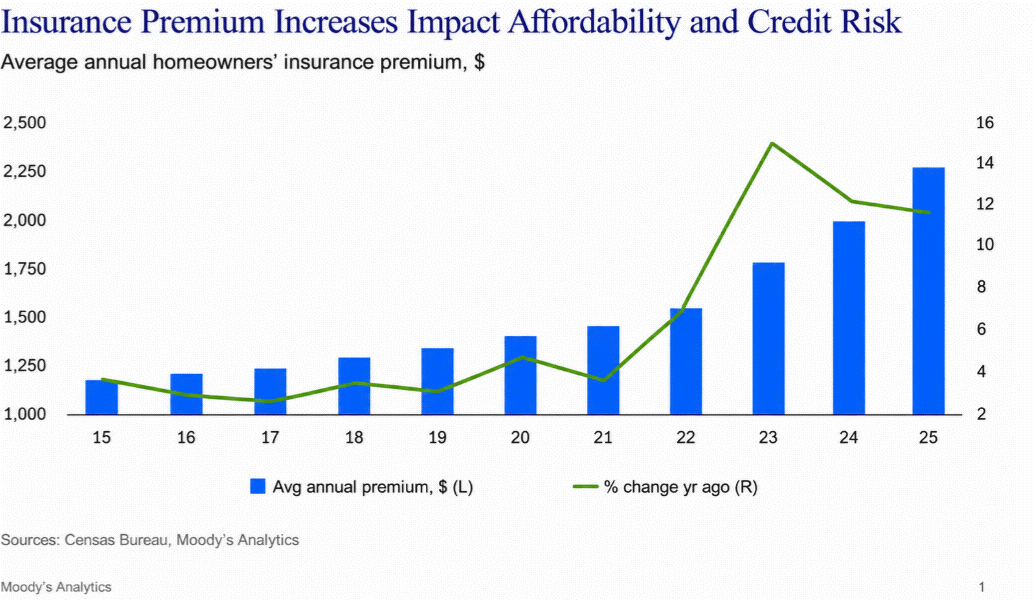
Recent data from Intercontinental Exchange illustrates the point. Analyzing roughly 13 million single-family mortgage holders, ICE found that borrowers in the highest quintile of insurance-expense burden, measured as the share of total housing costs allocated to property insurance, were at least 22% more likely to be delinquent than those in the lowest quintile. Correlation is not causation, but the signal is directionally consistent with consumer theory: When insurance consumes a larger share of housing costs, financial fragility rises.
Underinsurance is compounded by how the risk itself is measured. Backward-looking, deterministic pricing models, which extrapolate future losses from historical averages, generally understate the risk communities now face from perils such as flood. Moody’s research puts a number on this flood insurance gap: Aggregate nationwide uninsured residential flood exposure is roughly $375 billion to $1 trillion across a range of extreme events, a protection gap of 65% or more.
Closing that gap requires not only greater insurance participation but also better risk transparency. Advances in high-resolution flood modeling and property-level risk assessment are helping insurers, lenders, communities, and policymakers understand where risk is concentrated and where mitigation investments can have the greatest impact.
The FAIR Plan Paradox
Insurers of last resort, known as FAIR Plans in most states and as Citizens Property Insurance in Florida, were designed as limited backstops for homeowners who could not find private coverage. They were never meant to become primary markets. Yet in the most exposed parts of the country, that is increasingly the role they play.
Why this matters comes down to the assessment mechanism. When residual-market losses outrun a pool's capital and reinsurance, the shortfall is recovered through retroactive assessments on the private carriers licensed to write insurance in the state. A carrier that has retreated from a market still carries a contingent liability to that market's pool, and it carries that liability in proportion to its historical share rather than its current exposure. Carriers then pass the cost through to policyholders as a surcharge, in effect a tax spread across the state. There is no clean exit; pulling back from the market does not release an insurer, or its customers, from the bill.
Florida offers the clearest recent example. Citizens Property Insurance swelled to roughly 1.4 million policies at its 2023 peak. Legislative reforms targeting litigation abuse have since cut the count sharply, to roughly 385,000 by the end of 2025. But the private market’s return reflects regulatory change, not a genuine drop in physical risk. Florida remains acutely exposed to rising seas and intensifying hurricanes that could put its public plan at risk.
California shows the same dependence building through a different channel. FAIR Plan enrollment surged between September 2024 and December 2025 as major carriers exited in the wake of catastrophic wildfires. The state's insurer of last resort now holds $750 billion in insured exposure across 684,000 policies, more than quadrupling since 2021.
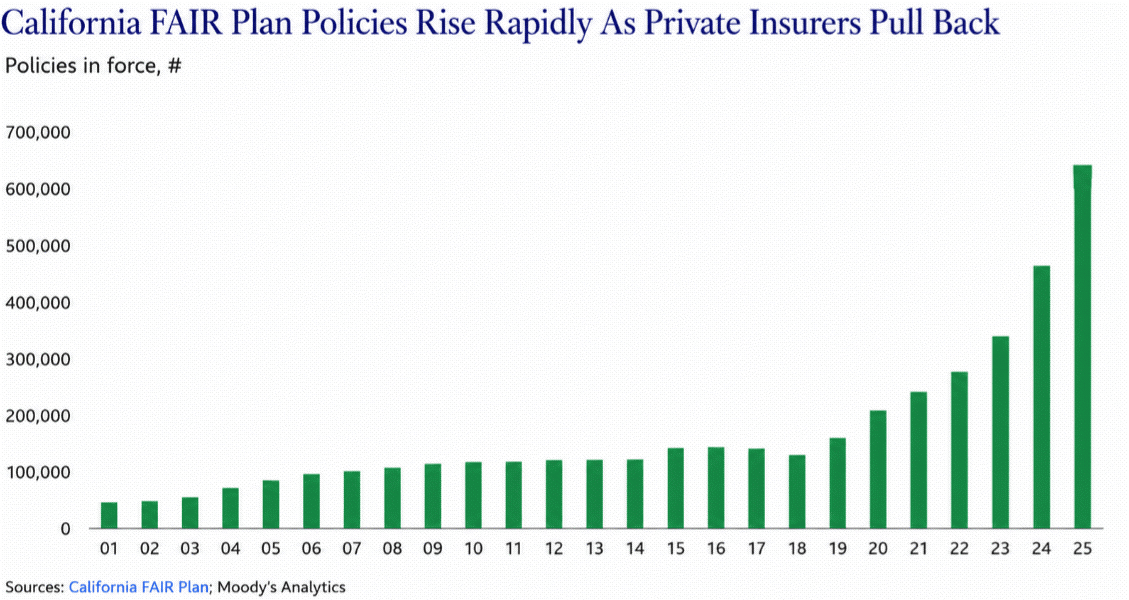
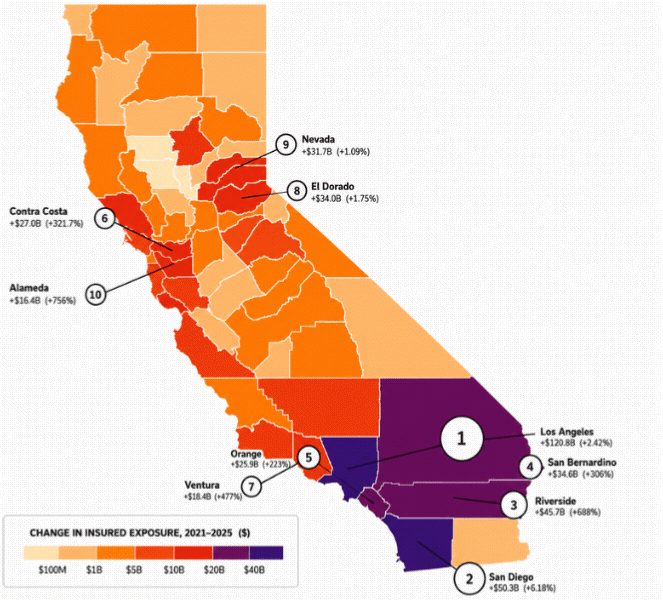
This growth is also geographically concentrated. Although the California FAIR Plan operates statewide, 54% of the exposure added since 2021 sits in just five Southern California counties.
California FAIR Plan exposure growth, 2021–2025, by county
The 2025 Los Angeles wildfires showed what this concentration costs. California's FAIR Plan faced an estimated $4 billion in wildfire losses and triggered a $1 billion assessment on participating private insurers, a textbook case of a concentrated loss in a residual market flowing outward to the broader market through the mechanism described above.
Massachusetts illustrates a different version of the same hidden risk. In 2024, its FAIR Plan posted the largest single-year enrollment increase since 2007, yet no single catastrophe set it off. The state had simply left its rates untouched for roughly two decades, even as rebuilding costs and premiums climbed.
This was not a market in equilibrium. It was a market in a holding pattern, absorbing stress through the public backstop while pricing stayed capped waiting for the next shock.
In many states, these public risk pools lack the capital to withstand the extreme losses they now face, especially where political limits on pricing have further weakened their financial cushions. That is the paradox: The more a pool holds its rates down to remain affordable, the thinner its financial cushion becomes, and the larger the assessment that private carriers and their policyholders will ultimately absorb when a shock arrives.
The Retreat of the Federal Backstop
For decades, the implicit bargain in American disaster risk was simple: When private markets fail and state markets are overwhelmed, the federal government steps in. Federal Emergency Management Agency (FEMA), the National Flood Insurance Program (NFIP), and Community Development Block Grant allocations collectively served as a backstop that allowed households, lenders, and local governments to behave as though catastrophic losses would always be partly socialized.
This assumption is now under pressure from multiple directions. Federal debt dynamics, discretionary spending caps, and active debates over FEMA’s mandate all point to a future in which disaster relief may be less automatic, less generous, or more delayed than markets have historically assumed.
If this shift proves durable, markets may increasingly differentiate between communities based on underlying hazards, mitigation, and insurance availability. For lenders and investors, understanding how disaster assistance assumptions are reflected in property values and credit risk may become increasingly important. Mortgage credit availability may tighten or, in tail-risk scenarios, be withdrawn altogether.
Structural Parallels Worth Noting
Several features of today's insurance market resemble conditions that have historically produced systematic under-assessment of risk. Insurance premium data is a lagging and incomplete signal of household risk exposure. Deductible and coverage gaps accumulating on household balance sheets are not systematically tracked, disclosed, or incorporated into mortgage underwriting. Credit models do not consistently treat insurance burden, or borrower exposure net of insurance, as a primary risk driver.
These blind spots are not hypothetical. The conditions for systematic under-assessment of risk are already present today, and without changes to how insurance burden and coverage gaps are tracked, they are likely to worsen.
Behind the affordability story is an evolving analytical and regulatory effort to keep catastrophe risk assessment aligned with a shifting hazard environment. Advanced catastrophe models, such as Moody’s RMS models, continue to evolve and incorporate granular exposure data, changing hazard conditions, and detailed vulnerability characteristics, supporting sharper differentiation across windstorm, wildfire, flood, and severe convective storm perils.
In parallel, regulatory frameworks from bodies such as the California Department of Insurance and the National Association of Insurance Commissioners (NAIC) are pushing risk-based approaches that recognize forward-looking signals and the credit given to mitigation, while balancing affordability, availability, and solvency. State-level initiatives that account for land-use planning, building standards, and defensible space in wildfire zones, alongside recognition of property- and community-level flood mitigation, are intended to strengthen the link between physical risk reduction and financial outcomes.
Taken together, these developments aim to ensure that insurance continues to serve its core economic purpose of facilitating predictable risk transfer, rewarding loss-reducing behavior, and stabilizing household and lender balance sheets. Progress here matters most where it is hardest to make. Specifically, changes are needed to limit growth in residual-market exposure and slow the accumulation of contingent risk on public balance sheets.
Implications for Risk Managers
Given these emerging trends, how should risk managers respond? A few practical steps stand out:
Insurance premium data is necessary but insufficient. Average premium growth captures only one dimension of household insurance burdens. Assessing coverage quality, not just coverage existence is a must.
Insurance burden is an early-warning credit signal. The ICE findings suggest that the share of housing expense devoted to insurance correlates with delinquency risk in ways that traditional credit variables do not fully capture. Mortgage models that incorporate insurance burden alongside loan-to-value ratios, credit scores, and debt-to-income ratios are likely to be more predictive of credit risk.
FAIR Plan concentration is a portfolio tail risk. Investors in RMBS pools concentrated in FAIR Plan markets are effectively exposed to the risk of large assessments, rising insurance costs, and disruptions in coverage availability following major catastrophe events. Loan-level disclosure of carrier type, peril coverage, and deductible levels would enable a quantitative assessment of FAIR Plan exposure across an RMBS portfolio.
Reduced federal backstop support is a repricing catalyst. Portfolio stress tests should include scenarios in which federal disaster aid is materially reduced and/or delayed.
The Bill Is Already in the Mail
The cross-subsidies embedded in pooled insurance, federal backstops, and backward-looking pricing that once spread catastrophe risk across space and time are unwinding. The households most exposed to this unwinding are not necessarily those in the highest-hazard zones. They are the households that responded to premium increases by hollowing out coverage, trading visible premium savings for invisible risk retention.
Aggregate insurance premium data may continue to show moderation as average cost growth slows. That should not be mistaken for a stabilization of household risk exposure. When disaster risk becomes a significant cost of living, its impact is not distributed evenly. It falls selectively and disproportionately across households, often in ways that remain hidden beneath headline premium trends.
Cristian deRitis is Managing Director and Deputy Chief Economist at Moody's Analytics. As the head of econometric model research and development, he specializes in analyzing current and future economic conditions, scenario design, consumer credit markets, and housing. In addition to his published research, Cristian is a co-host of the popular Inside Economics Podcast. He can be reached at cristian.deritis@moodys.com.
Firas Saleh is Director of North American Wildfire and Flood Models at Moody's. He works closely with stakeholders and cross-functional teams across Moody's to define and execute the strategic vision and roadmap for the company's flood and wildfire peril models. He can be reached at firas.saleh@moodys.com.
Topics: Modeling, Resilience, Data