
“A year or two ago, if our fraud system spotted a bot executing a transaction, we blocked it. Today, that same bot activity could be a legitimate customer using an AI agent to make authorized purchases.”
Those words of Andrew Lambert, senior vice president and head of product, Cross River Bank, lead to a problem statement for the age of agentic commerce. KYC – know your customer – is a known and essential concept in establishing financial relationships and maintaining them in compliance with anti-money laundering and other requirements.
When AI agents are the transactors, as Lambert points out, “The rules are unchanged, but the reality of processing these transactions is completely different.”
KYC morphs into KYA, know your agent.
If only the solution were as simple as the problem is stated. Even as agentic artificial intelligence is actively embraced by individuals and institutions, it introduces risks that give managers pause. These have been nowhere more concerning than in bots that escaped controls of frontier AI labs.
Proceeding with Caution
“You don’t want rogue agents, and it could be thousands of them,” said Jamie Dimon, chairman and CEO of JPMorgan Chase & Co., which is not allowing external AI agents to act on behalf of retail customers.
Fed Governor Michael Barr
United Airlines also banned third-party AI agents: “While we see the significant possibilities they may have, we want to establish standardized, secure technology integrations with privacy, security, authorization and accountability protections in place.”
“All of this depends on having a structure that leaves people ultimately in control,” Federal Reserve Governor Michael Barr said on November 19 at the FinRegLab AI Symposium. In the agentic commerce “direction of travel,” a system of keeping bots out evolves into “let[ing] selective bots in,” with assurance that “the Ai agents are acting with genuine authorization of the consumer; the agent is acting in alignment with the consent given for the particular action to be taken; and merchants and the financial sector and people on the other end of that are confident . . . controls [are] in place to know that those things are actually true.
“A lot of work has to go into making it a trusted mechanism.”
AI Agents Should Not Access Financial Accounts Just Yet, a Bank Policy Institute analysis by senior fellow Greg Hopper, points to “a lag between AI agents’ rapid development and nascent risk management practices, especially for financial applications. Right now, the risk that an AI agent could make mistaken or fraudulent financial decisions is high.
“Because banks and other financial institutions are responsible for the safety of the funds and assets their customers have entrusted to them and are the only place to call when anything goes wrong, they have attempted to restrict unvetted AI agents from accessing bank accounts. It remains to be seen whether such efforts will continue to be necessary and practical,” writes Hopper, a former Goldman Sachs and Morgan Stanley risk executive.
“Agents Coming at Them”
Companies “are doing a fairly good job of identifying the internal agents – the ones they’ve developed for their own productivity use cases,” observes Avivah Litan, an independent board and strategic advisor. “But they have no clue about these other agents coming at them.”
Stu Bradley of SAS
Saugat Nayak, MS, Business Analytics, Southern Methodist University Cox School of Business, says AI is evolving from decision-support tool to autonomous actor, capable of initiating workflows, rearranging portfolios and communicating with external parties “without a human examining each step.”
“The question for banks isn’t how quickly they can deploy agents,” says Stu Bradley, senior vice president of Risk, Fraud and Compliance Solutions at SAS, which in a recent report with IDC stressed the importance of trustworthiness if AI is to deliver on its potential. “It’s whether they’re aligning them to the right use cases – and with the right controls – to create value responsibly.”
The report, with results of a survey of 2,699 decision-makers in 28 countries, said, “Organizations want agentic AI for automation (56%), competitive advantage (52%), innovation (51%), scaling digital labor (48%) and faster decision-making (48%) . . . The problem is that trustworthiness, which ensures the technology can be trusted, has not kept pace with deployment ambition.”
Working on Trust
To Bradley, “agentic banking” is less a destination than a continuum. It is unrealistic to expect an overnight transition to autonomous AI being given unrestricted control.
“Banks will progress through stages – agents addressing questions, advising humans, recommending actions subject to approval, executing narrowly defined tasks within established thresholds. Only then will they perhaps consider greater autonomy in specific low-risk or highly controlled workflows,” Bradley explains.
When even state-of-the-art agents can have error rates exceeding 25% on complex tasks, banks cannot make a complete leap to autonomy. They must accumulate more real-world experience with agentic AI to build confidence in how those agents behave within established governance and guardrails.
The desired trustworthiness “requires strong leadership to invest in a persistent technology strategy while ensuring people remain at the center of oversight and governance,” Bryan Harris, executive vice president and chief technology officer, SAS, wrote in the Data and Ai Impact Report’s introduction. “Organizations that do this successfully will overcome the trust barrier, achieve groundbreaking outcomes, and gain a competitive advantage in the market with AI.”
Bradley says that for risk professionals in this loop, “it will no longer be enough to ask, ‘Can we trust this model?’ They’ll need to widen their scope to include questions around the data that agents can access; decisions they can make; actions they can execute; other systems or agents with which they can interact; and points at which humans must intervene.”
Preparing for Volume
“Treat KYA as part of the fraud and BSA [Bank Secrecy Act] program, not a separate IT project. Own it in the first line, challenge it in the second, test it in the third,” per Boyang Dong, Coalition Against Financial Crime, on LinkedIn.
Some see solutions for KYA in “infrastructure.”
Avi Pilcer, Ultra Deep Tech
“Agentic commerce building blocks are being built on old rails, with fintechs (not banks) writing the rules,” Efi Pylarinou, “fintech influencer” and advisor, said in a LinkedIn post. “Every agent a bank locks out can come back through a fintech card, and then the bank is increasingly left out of shaping the new world.”
“Never trust the agent’s self-description,” advises Avi Pilcer, founder and CEO of Ultra Deep Tech, which claims its autonomous AI infrastructure “plans, executes, monitors and self-corrects entire business operations without human supervision.”
Pilcer, the author of Securing AI in Finance, says: “Bind every agent to a verified principal, a human or an organization, with an explicit, scoped, revocable mandate. And log every action so the chain from instruction to transaction can be replayed. KYA is KYC plus a delegation record and an audit trail.”
Baselayer, whose platform provides business-identity verification and risk infrastructure to more than 2,300 financial institutions and payments companies, announced a $35 million Series A financing in September along with an “Agentic Identity Suite, bringing the industry’s first interoperable trust layer and agentic fraud consortium to the global agentic economy.”
“Every era of commerce has required a new trust layer, but historically that infrastructure gets built only after fraud and abuse make the problem impossible to ignore,” said Baselayer co-founder and CEO Jonathan Awad. “Agentic commerce is moving too fast for the industry to repeat that mistake. We already help one in five U.S. financial institutions answer, ‘Can I trust this business?’ Now we’re building the infrastructure they need to answer, ‘Can I trust this agent, who does it represent, and what is it allowed to do?’”
Data and Context
Cross River, which supports fintech ecosystems with embedded banking and other services, is “working with partners like Visa and Stripe developing the components that make verifiable, continuous consent possible,” according to the article by head of product Lambert:
- “Agent directories that let merchants distinguish between authorized agents and malicious bots at checkout.
- “Tokenization with context: not just encrypted credentials, but embedded metadata that answers who the consumer is, who the agent is, what the consumer authorized the agent to do, and whether the agent is staying within those boundaries.
- “Transaction-level indicators that tell fraud systems this is a trusted agent acting on delegated authority.
- “Continuous consent monitoring that tracks whether the user's permission is still valid across interactions spanning hours, days, or months.”
“Without these signals embedded in the flow,” Lambert said, “you can't scale agentic finance safely.”
Payment Initiatives
Baselayer noted that in June, Stripe reported that 70% of the commands used to access data through its API came from AI agents; Visa, Mastercard and American Express had all shipped agentic commerce protocols; and “Shopify turned on agentic sales channels by default for roughly one million merchants.”
Chris Radkowski, Pathlock
“The more consequential build-out is in infrastructure,” asserts Chris Radkowski, SAP GRC expert with identity and access governance vendor Pathlock. While payment networks are shipping agent-specific protocols, “settlement keeps getting faster, which compresses the time available to catch and reverse a mistake.”
Ant International, Mastercard and Visa are collaborating on a KYA interoperability framework “to help card networks, digital wallet ecosystems, agent platforms and marketplaces streamline agent onboarding and identification across networks, based on shared principles while preserving each network's own verification and decisioning processes.”
Interoperability across the respective frameworks “is essential to making agentic commerce work at scale . . . a consistent way to recognize trusted agents, verify that actions reflect the user’s intent, and preserve accountability across the transaction,” said Mastercard chief digital officer Pablo Fourez. “Mastercard [protocol] Verifiable Intent was designed for this open ecosystem, helping ensure that as commerce becomes more autonomous, every interaction remains secure, transparent and grounded in consent.”
“Payment networks are layering transaction-specific authorization on top,” Radkowski explains. “Visa's Trusted Agent Protocol binds a signature to a specific merchant domain and operation, with a time stamp and session identifier to block replay; and Google's Agent Payments Protocol uses ‘mandates,’ where an open mandate captures the boundaries a customer authorized and a closed, agent-signed mandate represents one specific transaction that a merchant verifies against those boundaries.
“Put simply: legitimacy is becoming a three-part test – cryptographic identity, a scoped and time-bound mandate for this specific action, and continuous monitoring – rather than a single check performed once at the door.”
Consumer Wariness
According to a PYMNTS Intelligence-Trulioo report, How Enterprises Can Build a ‘Know Your Agent’ Defense, 89.5% of 350 organizations surveyed said managing bot traffic is a challenge, and 52.3% reported an increase in bot traffic over the prior year. Those keeping digital identity verification in-house face a more pronounced exposure to adversarial bots and agents, but consistency and expansion problems were associated with external teams.
Behavior-based security and antifraud company BioCatch’s AiRE (Agentic AI Risk Essentials) detects agents interacting with digital banking platforms in real time.
“Whether banks plan to block all agents, grant access to only certain, pre-approved agents, or open the floodgates and allow any agent to access their platforms, those institutions must be able to first reliably detect whether the entity controlling a session is a human or an agent and if the intent of that entity is genuine or malicious,” BioCatch chief product officer Ayelet Eliezer said in a November 10 announcement. “Artificial intelligence capabilities for consumers, institutions, and bad actors alike are evolving rapidly.”
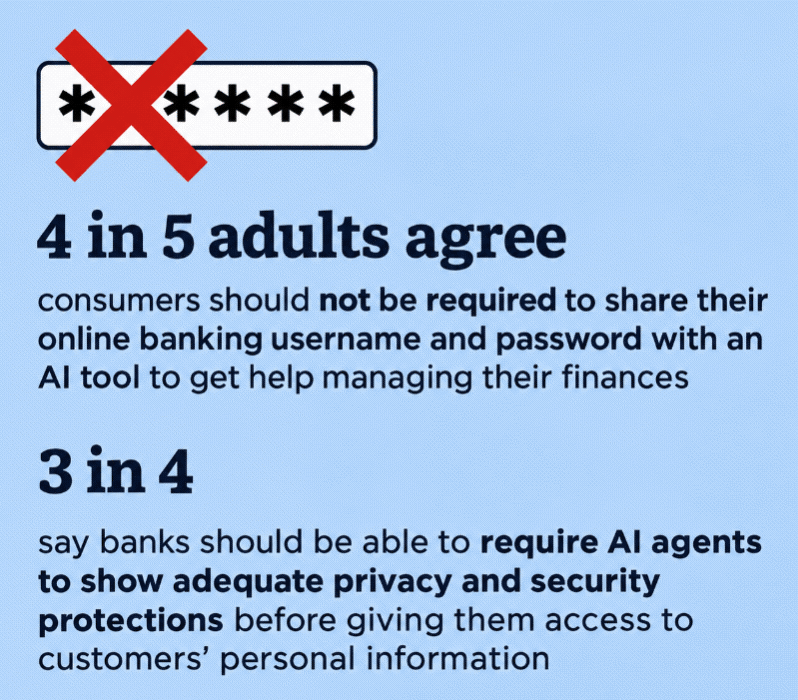
Source: American Bankers Association
BioCatch cited a recent American Bankers Association survey highlighting consumer wariness of AI personal finance tools, including security and privacy concerns.
Eighty percent in the poll agreed their bank should be able to detect whether it is dealing with a customer or an agent. Only 27% said they were likely to use an AI agent to autonomously manage cash balances in their bank account in the next 12 months.
ABA president and CEO Rob Nichols commented: “While agentic AI has the potential to be a compelling consumer tool, this survey shows that Americans are not ready to hand over their financial decisions to AI agents. Consumers clearly still value the safety and security of their bank, and they are understandably wary of allowing AI to move their money or access sensitive account information. They also want their bank to protect them from the risks posed by AI.”
OpenAI’s ChatGPT Wallet with agentic payment capability drew this reaction from Identity Theft Resource Center president James E. Lee: “The first thing to understand,” he told Yahoo Finance, “is that this is a frontier technology and is probably not appropriate for most people today. It’s better suited to early adopters who have a high level of risk tolerance and understanding of AI technology.
“With any personal agent, you need to be certain you understand how your personal information is going to be used, where it will be stored, what kind of permissions are required to approve a transaction, how you can revoke permissions to access your information, and the process for disputing any transaction made on your behalf.”
Jeffrey Kutler of GARP contributed reporting for this article.
Topics: Innovation, Cybersecurity, Third Party Risk