
According to the World Economic Forum’s Global Gender Gap Report 2026, women occupy far more senior positions today compared with 20 years ago, but they are still more likely to be in roles that carry less power.
Women hold 19.1% of chief executive jobs worldwide, and only one in 10 of the ministries headed by women is a powerful one.
This “points to a barrier in how positions are allocated rather than in the availability of talent,” the WEF finds.
India represents a 10-year test of how this has played out on company boards. The Companies Act 2013 required every listed company to have at least one woman director, from April 1, 2015. The securities regulator SEBI later required at least one woman independent director, first at the top 500 companies from April 2019, and then at the top 1,000 from April 2020.
What Was Accomplished
With data from the Indian Boards database, which covers every company listed on the National Stock Exchange (NSE), we took a snapshot of every board on March 31 each year from 2006 to 2025. The number of companies grew with the market, from 803 in 2006 to 2,597 in 2025, and 3,087 companies appear at some point in the 20 years.
For the nine years to 2014, women held between 4.3% and 5.5% of board seats. In the first year of the law taking effect, that jumped to 12.5%; the number of women directors more than doubled, from 637 to 1,466. By March 2025, women held 21.3% of the 19,539 board seats at 2,597 companies.
By comparison, women hold 43% of board roles at the U.K.’s largest 350 listed companies (under a voluntary target), and 33.7% of seats at S&P 500 companies in the U.S. The EU’s Women on Boards Directive targeted 40% of non-executive seats by June 2026.
India began from a much lower base, and its rule specified one seat rather than a share of the board. The result, after the initial spike, was slow growth.
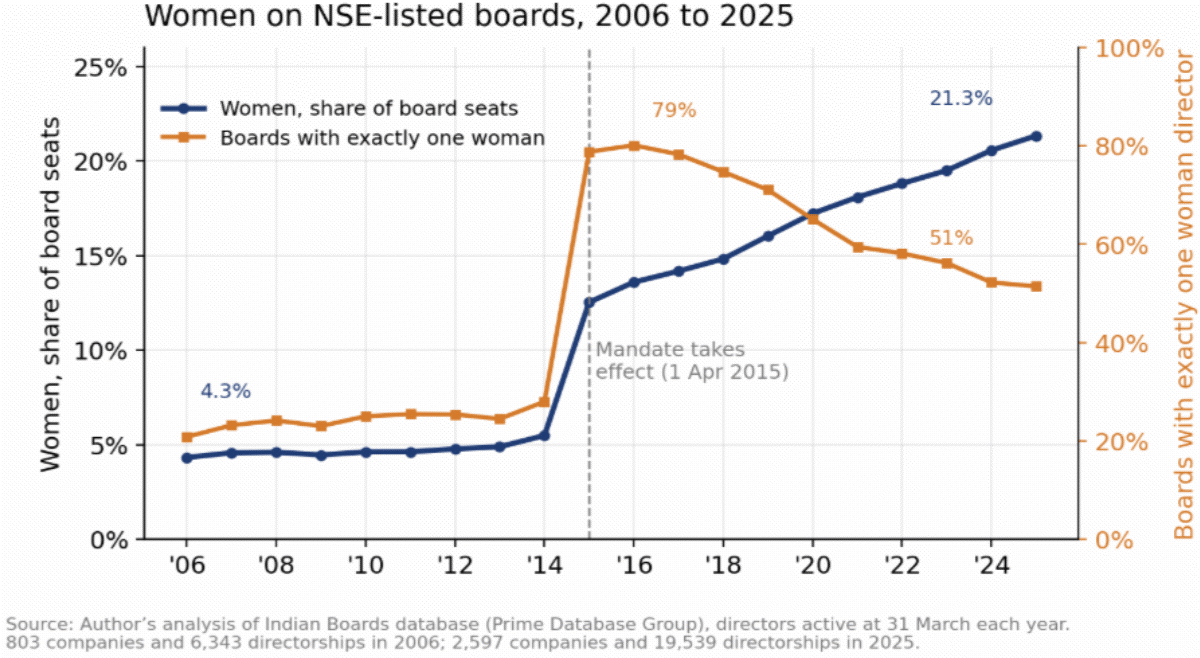
Figure 1. Women’s share of board seats, and the share of boards with exactly one woman director, NSE-listed companies, 2006 to 2025.
Were There Enough Qualified Women?
In a 2023 GARP commentary, Sharon Bentley-Hamlyn of Aubrey Capital Management in the U.K. argued that sustainability ratings punish well-run companies because “there simply are not enough qualified women coming forward” for board roles.
Taking India as a test case, from March 2014 to March 2025, the number of women on NSE-listed boards went from 637 to 4,168. If companies had met the law by appointing whoever was at hand, we would expect to see those women in seats that do not require independence, such as family members or executives.
That is not what happened. In March 2025, 64% of the women directors were independent, compared with 46% of men.
In the two years after the law took effect, 68% of the women appointed were independent and only 11% were promoter directors (members of the founding or controlling family). There were qualified women; companies simply had not looked for them.
Counting the Chairs
In March 2015, 79% of NSE-listed companies had exactly one woman director. That fell to 51% in 2025.
In March 2025, women were only 6.6% of board chairs. On audit committees they held 21.7% of seats and 16.6% of the chairs; on risk management committees, 15.2% of seats and 11.8% of chairs. Only on nomination and remuneration committees was the percentage of women chairs (24.7%) higher than that total seats.
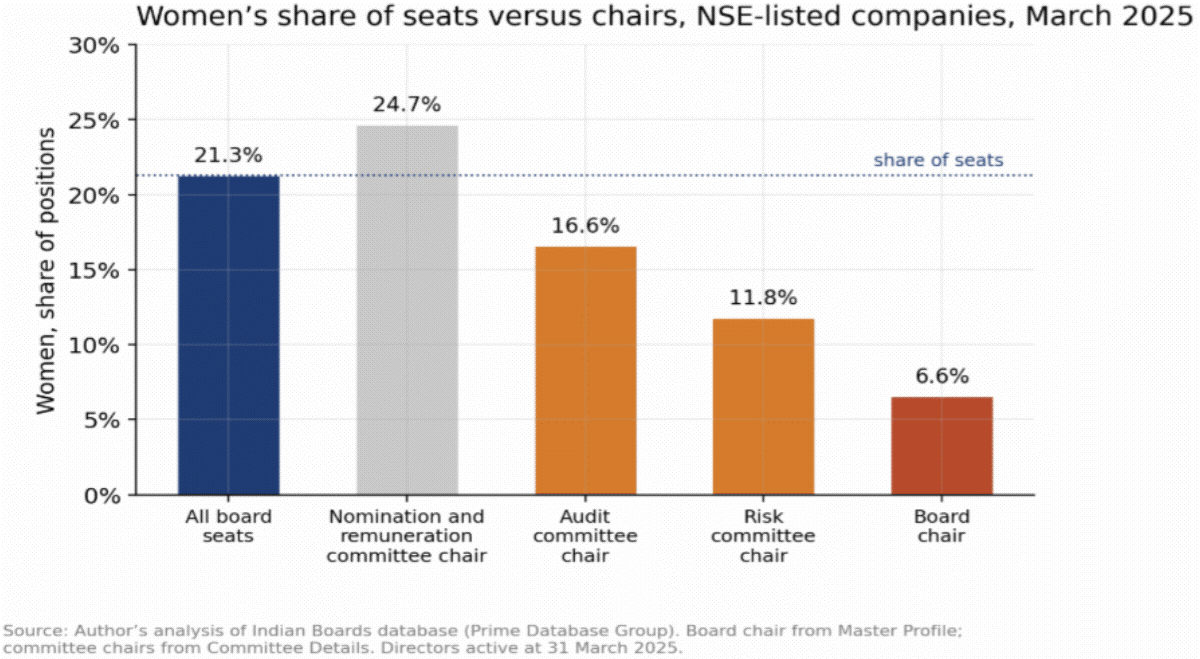
Figure 2. Women’s share of board seats compared with their share of board and committee chairs, NSE-listed companies, March 2025.
Ownership Effect
Who owns the company also shapes who gets appointed.
In 2013, 46% of the women on family-controlled boards were promoter directors. At companies without a controlling family, the figure was 9%. By 2025 the family-member share among women directors at family firms had come down to 22%, because most new appointments were independent.
However, in the first two years after the law, a woman appointed to a family-firm board was still 13 times more likely to be a family member than a woman appointed at a non-family firm (13.2% versus 1.0%). Most family firms met the law with an outside appointment; a sizable minority did so from within the family, as our peer-reviewed work shows in more detail.
Questions for Evaluators
The share of women on a board goes into ESG scores, index rules, and how lenders and investors judge a company’s governance. If that share is the only thing counted, a board with two women who chair nothing gets the same score as a board with two women who chair the audit and risk committees.
A few simple checks do better than the headline numbers.
Does the board have exactly one woman? If so, it has probably done the minimum.
Do women chair the audit and risk committees in the same proportion as they hold seats? If not, they are unlikely to be where the oversight work happens.
At a family-controlled company, how many of the women directors are members of the owning family? A high number means the board is less independent than it looks. All of this is in the annual report, and any ESG rating or lender’s checklist that already counts women on the board could ask these questions as well.
The World Economic Forum report says the barrier is in how top jobs are handed out, and India’s board data say the same. Ten years after the law, India has more than 4,000 women directors, and half its boards have exactly one. The number of women on the board has become an easy governance question. Which of them chairs the audit committee is a harder one, and reveals more.
Nupur Pavan Bang (npbang@gmail.com) is Founder and Chief Family Business Navigator, Bodhi Advisory & Nurturing Group. Her advisory work spans succession planning, family constitutions, ownership transitions, sibling and cousin dynamics, professionalization and the role of women in family enterprises.
Topics: Enterprise, Regulation & Compliance