
Innovations in lending and investing that have particular appeal to young and less affluent populations may be increasing the risk exposures of traditional financial firms that lack insight into those markets.
Bank of America Securities analysts late last year flagged gambling and prediction markets as an emerging contributor to credit risk.
"Easy access and gamified interfaces encourage frequent and impulsive wagers, which can lead to overextension of credit and rising loan defaults,” said a BofA report cited by Yahoo Finance. “For investors, this convergence of entertainment and speculative finance signals heightened behavioral risk that could pressure credit quality, increase delinquencies, and impact earnings for issuers and subprime lenders.”
"Liquidity stress indicators are mounting,” as one in four bettors report missing bill payments because of wagers they made, and 45% lack adequate emergency savings, according to a U.S. News survey.
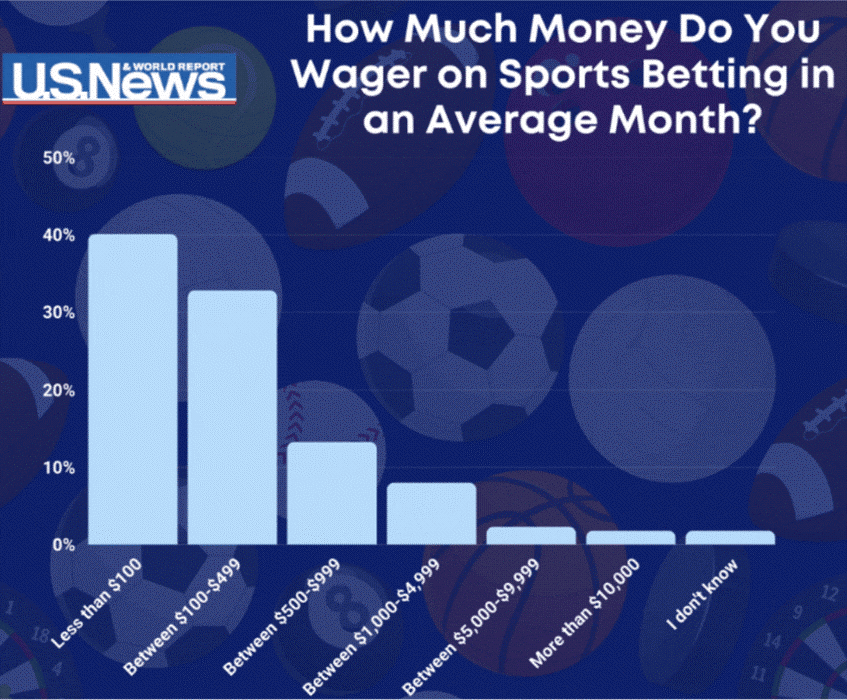
In the U.S. News survey of 1,200 sports bettors, 27% wager at least $500 a month. That includes 45% of those with household incomes of at least $150,000.
Start of a Wave?
Signs of serious distress are so far largely anecdotal, as related in a mid-February Business Insider article. “The amount Americans spend on event contracts on platforms like Kalshi, Polymarket, Robinhood and Crypto.com is still only a fraction of what they spend at brick-and-mortar casinos and on state-regulated gaming and sportsbooks apps,” it said.
Kalshi, the leading U.S. prediction market, made an estimated $263.5 million in fees last year, while all U.S. gambling businesses netted $71 billion through November, the American Gaming Association said. Wagers on February’s Super Bowl were still predominantly on sportsbooks.
According to BofA Securities, credit card issuers and non-prime lenders “face elevated exposure as behavioral risks intersect with liquidity stress,” with Bread Financial, Upstart, and One Main Financial particularly exposed to credit-stressed consumers.
Academic research finds that bankruptcy filings rise, and credit scores fall by an average of 2.75 points, when online access is enabled for sports gambling. FanDuel and DraftKings, which together comprise a majority of the online sports betting market, have stopped taking deposits by credit card, a practice that several states prohibit.
“Net-net,” BofA Securities concluded, “online betting markets introduce a new risk for lenders, one that they have not had to deal with historically, and underwriting models may need to adapt.”
Call for Visibility
Credit risk may also be embedded in buy now pay later (BNPL) programs.
In December, seven state attorneys general sent letters to Affirm, Afterpay and four other leading BNPL lenders requesting information about their products and businesses. This followed action by the Trump administration that lifted Truth in Lending Act disclosure and consumer protection requirements.
“The limited visibility into this debt paired with growing concern that they are concentrated among financially struggling borrowers is why the coalition is taking a closer look,” said a statement from the office of California Attorney General Rob Bonta.
Kevin King, LexisNexis Risk Solutions
Prediction markets are regulated by the Commodity Futures Trading Commission (CFTC), which regards event-based contracts as derivatives. Kalshi and its rival Polymarket do not provide transaction data to the credit bureaus whose data is used by credit-score providers Fair Isaac Corp. (FICO) and VantageScore, which in turn populate lenders’ risk models. BNPL transactions are reported to the credit bureaus in a limited fashion, but neither are they included in the credit-score models.
BNPL, sports betting and prediction products are popular among the younger and less affluent market segments where banks seek to initiate what can grow into long-term relationships. Kevin King, vice president, credit risk and marketing strategy, LexisNexis Risk Solutions, said data shows that banks’ offering consumers’ first credit cards often results in profitable relationships that BNPL may be undermining.
“A lot of loyalty is created in those early years when a bank is the first to extend credit to a consumer,” King explained. He sees in the new programs “shadow or phantom debt” carried by a young and riskier population for which little data is available.
The BNPL Data Gap
The short-term, interest-free BNPL loans began to surge during the pandemic period. Providers did not report these loans to the major credit bureaus – Equifax, Experian and TransUnion – whose methodologies did not accommodate the credits’ short terms and often penalized BNPL borrowers’ credit profiles.
“Every organization that sells credit reports and scores in the United States is interested in getting their hands on that data,” said King, whose company provides a widely used alternative credit score that does not yet incorporate BNPL data.
Fair Isaac last June launched two versions of its FICO score that incorporate BNPL data. "By expanding our FICO Score 10 Suite with new models designed to incorporate BNPL data, we’re enabling lenders to more accurately evaluate credit readiness, especially for consumers whose first credit experience is through BNPL products,” Julie May, general manager of B2B Scores, said at the time.
Julie May, FICO
To address its research showing that a large number of BNPL loans opened within a short period could negatively impact consumer credit scores, FICO says it aggregates separate BNPL loans when calculating certain in-model variables. “This novel treatment has proven effective at capturing predictive signal from the inclusion of BNPL data while increasing FICO Scores for some BNPL borrowers.”
Nevertheless, said a FICO spokesperson, “None of the three major credit bureaus currently feed pay-in-4 BNPL account information into the calculation of FICO scores.”
VantageScore, a joint venture of the three main credit bureaus, does not currently include BNPL data in its scores, a spokesperson said, “as it’s not systematically reported yet.”
Declining to Report
Klarna, one of the BNPL leaders, says it reports term loans to Experian and TransUnion, but “because the U.S. credit reporting framework doesn’t yet adequately reflect how short-term BNPL products like Pay-in-4 are used by consumers, we’ve chosen not to report BNPL data in the U.S. at this time.”
AfterPay, which is owned by Block, notes on its website that it “does not currently report to credit bureaus in the United States, and we won’t until we see concrete evidence that BNPL data reflecting responsible payment behavior will help, not hurt, the credit scores of our customers.”
Block has piloted, and is beginning to open to other users, a Cash App Score based on models “which power Cash App Borrow, Afterpay, and Square Loans [and] use near real-time financial data instead of delayed credit bureau reports.”
Affirm began reporting to Experian and TransUnion in April 2025, saying an “overwhelming majority of consumers” pay back their BNPL loans, and at a higher rate than credit cards. Citing a study in conjunction with FICO last year, it notes that “Affirm loan data can lead to higher FICO scores and improved credit outcomes.” (See the company’s November 2025 explainer, People deserve credit for managing their money responsibly.)
Incentive to Change?
King of LexisNexis does not expect a regulatory requirement that BNPL data be incorporated in credit scores, but economic forces could persuade more BNPL lenders to follow Affirm’s lead in order to grow their businesses. He noted BNPL loans can serve as a pressure-release valve for consumers in credit distress, especially if repaying those loans improves their credit scores.
Other BNPL lenders may also conclude that consumers understanding the “carrot and stick” nature of BNPL, and the potentially positive credit-score impact can help grow their businesses.
In the interim, transaction monitoring systems can be used to identify whether a lender’s customers are actively engaged in the prediction or BNPL markets, and ascertain the risk.
“If I were a banker, I would adjust my risk algorithms to recognize BNPL trades, perhaps using the size of the loans or certain transactions, so that trades can be recognized and treated accordingly in risk management strategies,” said Naeem Siddiqi, senior advisor, risk and quantitative solutions, SAS.