
Climate change presents profound challenges for banks, affecting a range of prudential risks through both physical and transition risk channels. Regulators now expect firms of all sizes to embed climate-related financial risks into their core risk management processes. The U.K.’s Prudential Regulation Authority's (PRA) Supervisory Statement 5/25 marks a clear step forward with this expectation: climate scenario analysis (CSA) is no longer simply encouraged. It must inform strategy, risk appetite, capital and liquidity planning, and even reverse stress testing.
Josh W. Nowak
For small- and medium-sized banks the challenge is practical rather than conceptual, as banks are already familiar with stress testing. The difficulty lies in adapting established methods to longer term horizons, multiple climate scenarios, and the uncertainties of climate science, in a way that is proportionate to their size and business mix.
This article describes an approach that small- and medium-sized banks can take when embedding climate scenario analysis, and looks at:
- Why CSA matters: Supervisory expectation, strategic resilience, clearer decision making.
- How it works: Short-term scenarios (up to 5-years) test near-term shocks and planning resilience; long-term scenarios (10 to 30 years) explore structural changes and strategic sustainability.
- A roadmap: Three phases for firms to consider:
- Foundations: build awareness, governance, and scope.
- Embed CSA: deliver proportionate short- and long-term analyses, link to Internal Capital Adequacy Assessment Process (ICAAP) and Internal Liquidity Adequacy Assessment Process (ILAAP), and report to the Board.
- Iteration: broaden coverage, close gaps, update with evolving data and scientific developments, and ensure adequate resources.
Why Climate Scenario Analysis Matters
Climate change is creating long-term shifts in weather patterns, and has consequences beyond environmental and societal effects. For banks, it directly impacts the risks they are exposed to. Understanding these implications is crucial, as it allows them to make better strategic decisions, remain competitive, and evolve their risk frameworks. A key part of this process involves climate scenario analysis.
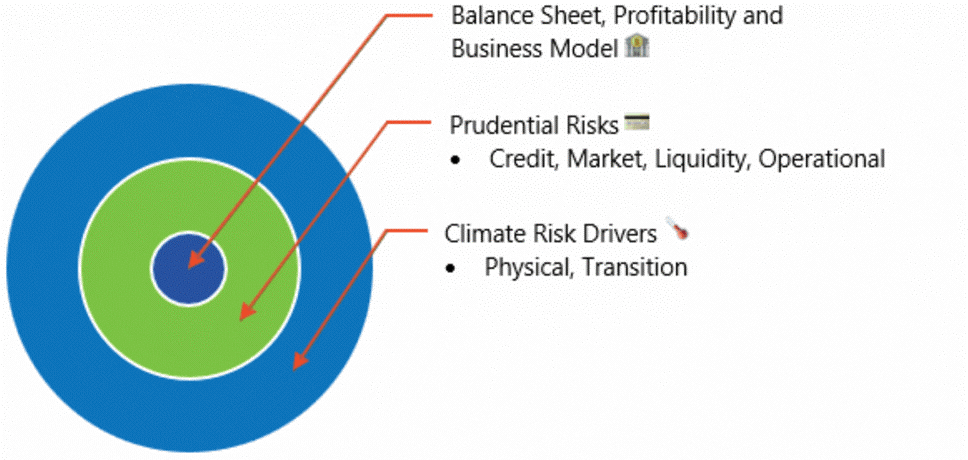
Figure 1: Climate risk drivers transmit through traditional prudential risk categories, ultimately affecting a bank's balance sheet and business model.
Supervisory Statement 3/19 (SS3/19), introduced by the PRA in 2019, set the U.K.'s first supervisory expectations on climate-related risks. While impacted firms should have fully embedded their approaches to managing climate-related financial risks by the end of 2021, progress was uneven — the PRA's 2020 Dear CEO Letter highlighted some key gaps as well as several implementation challenges.
More recently, the PRA published updated supervisory expectations in Supervisory Statement 5/25 'Enhancing banks' and insurers' approaches to managing climate-related risks’ (SS5/25).
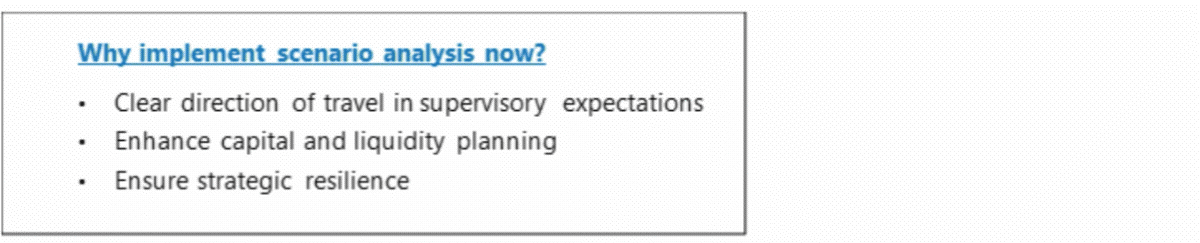
The new expectations mark a step-change from SS3/19, enhancing requirements in areas such as governance, risk management, data, disclosures, and climate scenario analysis. The heightened emphasis on scenario analysis is designed to ensure that firms incorporate climate-related considerations into their strategic decision-making, risk appetite setting, and the management of both capital and liquidity. Under SS5/25, scenario analysis is no longer simply encouraged: it becomes a clear supervisory expectation. Any fallback or alternative approach in its absence will likely be subject to challenge and would require strong justification and rationale.
What is Climate Scenario Analysis?
Scenario analysis is a useful tool both for the quantification and understanding of risk, as well as for strategic planning and decision making. It allows a bank to analyze the financial impacts of specified scenarios on its balance sheet, capital, liquidity, risk positions, profitability, and franchise, both quantitatively and qualitatively.
It can be used to assess the robustness of business models and strategic plans against a spectrum of plausible climate pathways, and to evaluate the implications of climate-related risk drivers for a bank's overall risk profile.
Climate scenario analysis is fundamentally like a traditional stress test used by banks in existing risk management processes such as the ICAAP. However, unlike traditional stress tests which focus largely on economic recessions and pre-existing operational risks, it is geared toward understanding the implications of risks linked to the low-carbon transition and physical climate events.
Challenges Faced by Banks
Despite being well-versed with stress testing and scenario analyses generally — these exercises in one form or another being carried out on a continuous basis for activities such as the ICAAP, ILAAP, Recovery Plan, and Solvent Exit Analysis — banks face some specific challenges in relation to climate scenario analysis.
These hurdles, shown in Table 1, are likely to be more practical than conceptual in nature, which may make them more straightforward to overcome, albeit a detailed approach is required.
Table 1: Hurdles to implementing climate scenario analysis.
|
Issue |
Challenge |
|
Short- and Long-term Horizons |
How to apply a long-term (30- to 50-year) climate scenario to a short-term (3-year) business plan? |
|
Integrating Scenarios |
How to incorporate long-term climate effects into short-term stress exercises when their impacts may unfold over decades? |
|
Scenario Selection |
How to select the most relevant climate scenarios and link scientific parameters (e.g., global temperature) to macroeconomic variables for modelling? |
|
Governance and Outcomes |
What to do with the results? How should the Board oversee, challenge, and review them, and how should they be integrated into processes like the ICAAP? |
The Varying Flavors of Climate Scenario Analysis
Prudential guidelines reinforce that there are different aspects to climate scenario analysis. For example, it could be done for different purposes (say, strategic planning versus resilience analysis) but might more simply be differentiated by the time-horizon considered, as shown in Figure 2.
Figure 2: Short- and long-term climate scenario analysis are both important, to address different questions
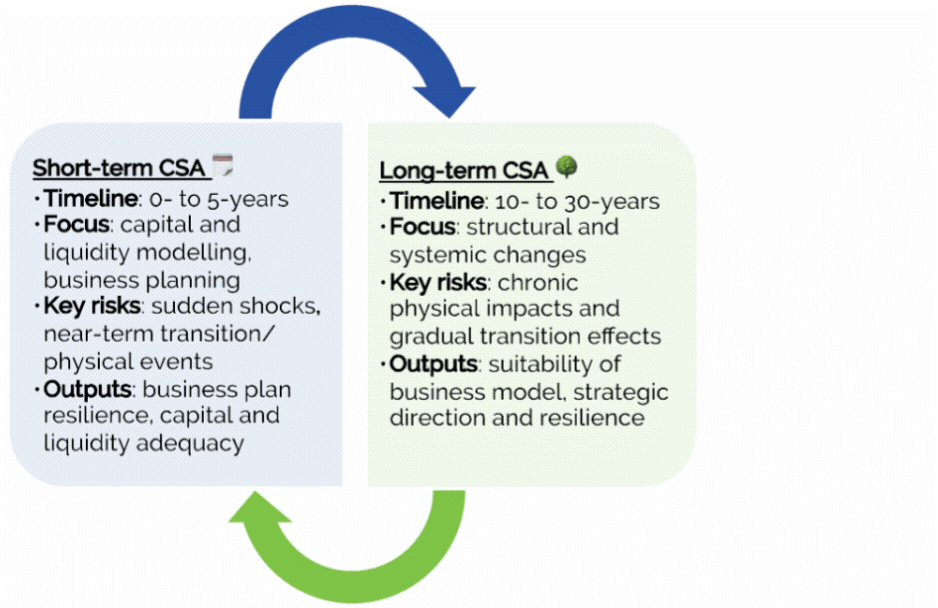
Short-term scenarios typically span periods of up to 5-years and are primarily used for applications like capital and liquidity modelling, and business planning. They can be ideal for evaluating risks that might emerge within a standard planning cycle or for testing a bank's resilience to sudden, unexpected physical shocks. However, the limited timeframe can make them less effective at capturing broader, system-level, impacts that unfold over longer horizons.
In contrast, the long-term scenarios extend over several decades. They are designed to explore structural shifts in the wider economy and to test the resilience of a firm's strategy and business model against these changes. But the extended horizons introduce considerable uncertainty into economic projections, and historical data offers little reliable guidance for assessing the scale or timing of unprecedented risks like those related to climate change.
These differing approaches within scenario analysis serve distinct yet complementary objectives and are crucial for comprehensive risk management and strategic planning. In practice, firms will benefit from applying both approaches owing to the specific focus of each variant.
Laying a Foundation for Climate Risk Management
"The secret of getting ahead is getting started," as the saying goes. We therefore look to lay a foundation to help small- and medium-sized banks commence their climate risk journey from an informed starting point, which aligns with proposed regulatory guidance, by showing actions smaller firms can take in the short- and longer-term, in Table 2.
Table 2: A Three-phased Roadmap for Small- and Medium-sized Banks
|
Phase 1: Foundations |
Phase 2: Embed CSA |
Phase 3: Iteration |
|
Objectives
|
Objectives
|
Objectives
|
|
Key actions
|
Key actions
|
Key actions
|
The roadmap is designed to be proportionate for small and medium-sized firms, while aligning with PRA guidance in SS 5/25.
Parting Thoughts
Climate scenario analysis is rapidly becoming a core component of prudent risk management, moving from an emerging concept to a formal supervisory expectation. While challenges remain, particularly around data, modelling, and integration across time horizons, banks that take a structured and proportionate approach will be better placed to manage emerging risks and make informed strategic decisions.
With a clear roadmap, small- and medium-sized banks can meet regulatory demands and use scenario analysis not only to comply, but to steer their strategy for a sustainable future.
Josh Nowak is an experienced risk and regulatory specialist at Katalysys with a strong track record in ICAAP, ILAAP, recovery and solvent exit planning, and IRRBB. He has delivered frameworks, models, and board-level insights for banks, supporting regulatory compliance, strategic decision-making, and complex liquidity and capital management initiatives.
Topics: Stress Testing & Scenario Analysis, Climate Risk Management