
Birthdays — and specifically 100th birthdays — have been a strong theme across the media recently, with an outpouring of affection and admiration as the U.K.’s greatest naturalist, Sir David Attenborough, celebrated his centenary. His extraordinary career and unparalleled contributions to our knowledge of the natural world and the pressures we have forced upon it have changed our understanding of the bionetworks which underpin every aspect of our lives — from climate stability and healthy ecosystems — and the intricate interdependence that allows all species, including our own, to thrive.
Jane Stevensen
At the venerable age of 100, Sir David continues to be a powerful voice for urgent change, with an uncompromising message to rewild the oceans, restore the forests, and rebuild the natural carbon sinks that protect humanity’s future. Achieving this requires a fundamental shift in how economies and businesses understand nature, not simply as a resource, but as a critical asset with measurable financial value and risk. The World Economic Forum’s 2026 Global Risks Report underscores the scale of the challenge, identifying environmental risks including climate change, biodiversity loss and ecosystem collapse as among the greatest threats to global economic stability. In response to this challenge, corporations and financial institutions, many of which exert significant pressure on ecosystems, are increasingly being asked to identify, disclose and reduce their nature-related impacts and dependencies.
The rapid increase in nature reporting relies heavily on corporate sustainability disclosure, which has undergone a major transformation over the past decade. While early reporting frameworks focused primarily on carbon emissions and climate change, the emphasis has increasingly shifted toward broader environmental risks, particularly biodiversity loss, ecosystem degradation and the financial consequences of nature decline. Today, nature-related disclosure is emerging as one of the most significant developments in corporate governance and sustainable finance.
The Task Force on Climate-related Financial Disclosures (TCFD), established in 2015 by the Financial Stability Board, played an important foundational role in this transition. Building on this foundation, the Taskforce on Nature-related Financial Disclosures (TNFD) was formally launched in 2021 in response to growing recognition that climate change is only one component of a much wider ecological crisis. Biodiversity loss, freshwater scarcity, deforestation, soil degradation and ecosystem collapse are now increasingly recognized as systemic risks to businesses and financial markets. The TNFD mirrors the TCFD’s four-pillar structure but expands reporting beyond climate into the broader natural environment.
The significance of TNFD lies in its focus on the relationship between economic activity and ecosystem health. Modern economies are deeply dependent on nature. Agriculture relies on pollination and fertile soils, manufacturing depends on stable water supplies, and financial systems are exposed to industries vulnerable to environmental disruption, for example. As biodiversity declines and ecosystems deteriorate, businesses face increasing operational, regulatory and reputational risks.
Alongside TNFD, several major international reporting systems and regulations are expanding the scope of nature-related disclosure. In the EU, the Corporate Sustainability Reporting Directive (CSRD) represents one of the most ambitious sustainability disclosure regimes globally. The CSRD significantly broadens reporting obligations for companies operating within Europe and requires disclosure under the European Sustainability Reporting Standards (ESRS). These standards include detailed requirements on biodiversity, water use, pollution, ecosystems and resource management.
Importantly, the CSRD embeds double materiality directly into regulation. Companies must therefore disclose both the financial risks arising from environmental degradation, and the environmental impacts generated by their operations. This creates stronger accountability across supply chains and investment activities while also aiming to reduce greenwashing.
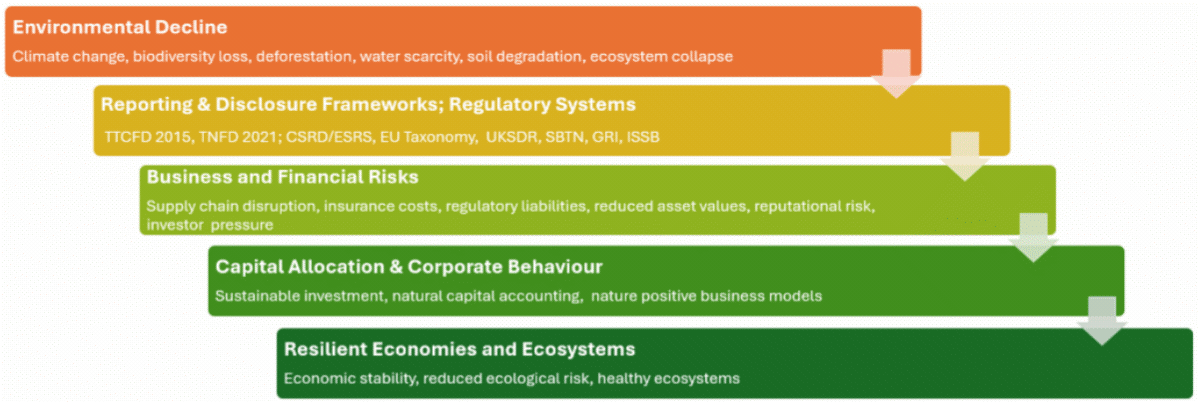
The EU has also introduced the Sustainable Finance Disclosure Regulation (SFDR), which requires financial institutions to disclose how sustainability risks are incorporated into investment decisions. Meanwhile, the EU Taxonomy establishes a classification system for environmentally sustainable economic activities. Together, these measures are designed to redirect financial flows toward sustainable and nature-positive investment.
In the U.K., environmental reporting has evolved through both regulation and voluntary market frameworks. The government has strongly supported TCFD-aligned reporting and is increasingly encouraging TNFD adoption as part of its green finance strategy. The Financial Conduct Authority has introduced Sustainability Disclosure Requirements (SDR) and anti-greenwashing measures aimed at improving transparency in financial products and investment markets.
The U.K. has also become a leader in natural capital accounting methodologies, which attempt to place measurable economic value on ecosystems and environmental services such as forests, wetlands, rivers and biodiversity. Institutions including the Office for National Statistics and the Natural Capital Coalition have developed frameworks to help businesses and governments integrate environmental assets into economic decision making.
Other important frameworks are also shaping nature disclosure practices globally. The Science Based Targets Network (SBTN) enables companies to set measurable environmental targets not only for carbon emissions but also for freshwater use, land systems, biodiversity and oceans. The Global Reporting Initiative (GRI) continues to expand biodiversity disclosure standards, while the International Sustainability Standards Board is working toward greater global harmonization of sustainability reporting.
Parting Thoughts
For businesses and financial institutions, the implications are substantial. Nature-related risks can disrupt supply chains, increase insurance and operational costs, reduce asset values and create regulatory liabilities. Investors are beginning to recognize biodiversity loss and ecosystem degradation as financially material risks comparable to climate change. Companies unable to demonstrate resilience to these risks may face reduced access to capital and growing shareholder scrutiny.
For the natural world, these frameworks represent a potentially transformative shift. By integrating nature into mainstream financial reporting and corporate governance, policymakers hope capital markets will increasingly reward sustainable business models and discourage environmentally destructive practices. Better disclosure may help drive investment toward ecosystem restoration, regenerative agriculture, biodiversity protection and sustainable resource management.
This all sounds very positive. So, can we report to Sir David that we are really getting to grips with these issues and account for (and hence act upon) the risks, to not only reduce them, but also in turn to improve outcomes for nature? Well, the challenges remain significant. Nature is far more complex and location-specific than carbon accounting, making standardized measurement difficult. Critics also warn that disclosure alone cannot reverse ecological decline without stronger enforcement and genuine behavioral change from corporations and governments.
Nevertheless, the rise of TNFD, EU sustainability regulation and natural capital methodologies signal a major change in economic thinking. Businesses are beginning to recognize that long-term profitability and financial stability are inseparable from the health of the natural systems upon which all economies ultimately depend.
Jane Stevensen is Founding Partner of JS Global Advisory, a specialist sustainability consultancy providing strategic, regulatory, and technical advice on climate and nature-related risk and opportunity.
Topics: Nature Risk Management