
Artificial intelligence’s ultimate impact on economies and productivity is debated by academicians and policymakers. However it shakes out, it will have real consequences on people and the jobs that they do.
According to an International Monetary Fund assessment, “40% of jobs globally are going to be impacted by AI over the next couple of years,” and 60% in advanced economies, IMF Managing Director Kristalina Georgieva asserted in January at the World Economic Forum in Davos, Switzerland.
“I tell people this is like a tsunami hitting the labor market. Are we ready? The honest answer is, no.”
Kristalina Georgieva: Tsunami coming.
Noting in a February speech that “many economically valuable tasks can (or may soon) be feasible using AI,” Federal Reserve Governor Michael Barr suggested, “The speed of AI adoption may be much faster than previous general-purpose technologies, boosting productivity growth, but also allowing less time for workers, businesses, and the economy to adapt to these changes.”
A February New York Times Corner Office column described “executives considering [AI’s] risks against its opportunities. While announcing major investments in AI, leaders must reassure employees that the technology isn’t coming for all their jobs while also being clear that it’s coming for some of their jobs.”
Amid the uncertainty, a number of workplace consultants and observers are advising companies to adopt a skills-based hiring strategy.
The tactic emerged over the past few years, prompted in part by effects of the COVID pandemic and recent tightness in the labor market, and now it is gaining steam as AI realities set in.
Simply put, skills-based, or skills-first, hiring does just that: It puts skills first – to bring people on board who are fit for the present but also capable of flexibility to meet future needs.
In a sense, it’s akin to adding utility players to the corporate team.
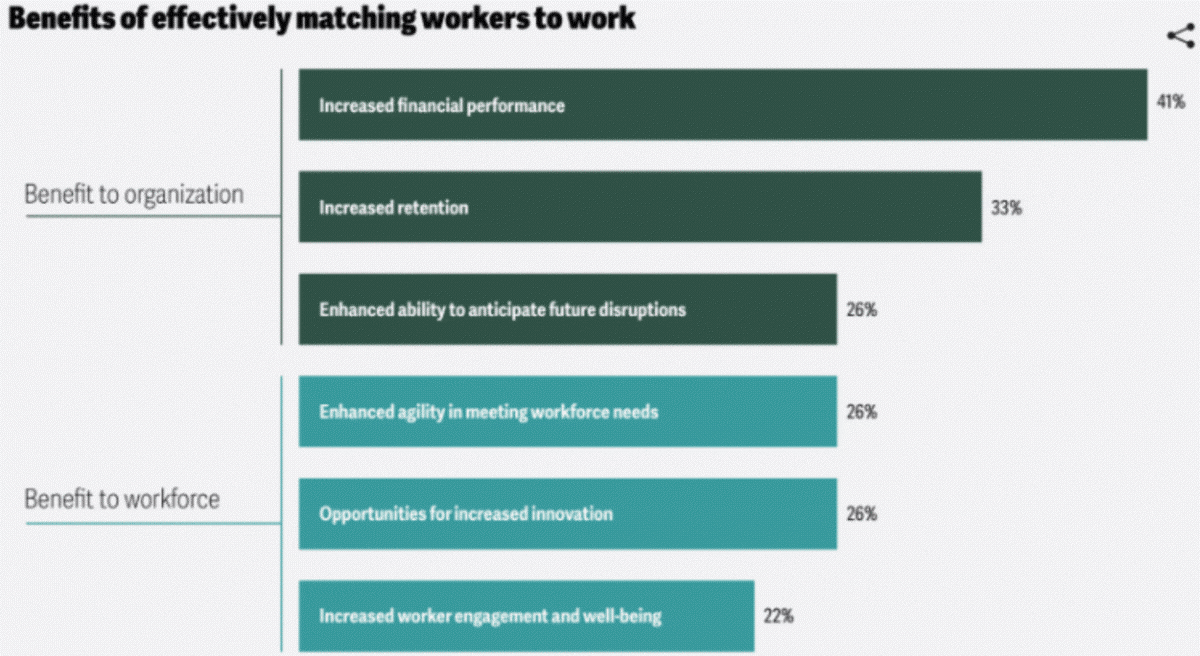
Source: Deloitte Global Human Capital Trends survey.
Changes in Workforce Planning
“Given the speed at which jobs are changing, workforce planning based entirely on job or headcount may no longer offer organizations the agility they need,” according to a Deloitte Insights paper on “rethinking how work gets done.”
“Workforce planners,” it says, “are increasingly using another unit of analysis to plan for the future: tasks to reflect work, and skills to reflect people – replacing jobs and employees, respectively.”
Deloitte pointed to its Human Capital Trends research, which found “jobs increasingly don’t reflect the work actually being done;” that “71% of surveyed workers already perform some work outside of the scope of their job descriptions, and only 24% report they do the same work as others in their organization with the same exact job title and level.”
The World Economic Forum’s 2025 Future of Jobs Report revealed that “on average, workers can expect 39% of their existing skill sets will be transformed or become outdated over the 2025-2030 period.”
“Skill gaps are categorically considered the biggest barrier to business transformation by [WEF survey respondents], with 63% of employers identifying them as such over the next five years.”
“People Risk” in Focus
Matt Sigelman, president of labor market analytics firm Burning Glass Institute and advisor to the Harvard Kennedy School Project on Workforce, co-authored a 2024 Fast Company article that characterized “clinging to outdated hiring practices” as “a critical business risk.”
“I don’t think you can effectively run a company without having talent management as part of risk management,” reasoned Clifford Rossi, professor-of- the-practice and executive-in-residence at the University of Maryland’s Robert H. Smith School of Business and director of the Smith Enterprise Risk Consortium (SERC). “When we talk about operational risk – proficiencies in people, processes and technology – people risk is a big area of focus.”
This applies to companies across the board, including in financial services, which are “highly dependent on human capital,” Rossi remarked.
On the subject of job cuts, consider comments in a YouTube posting by Tom Lee, Fundstrat Global Advisors managing partner and head of research, former JPMorgan Chase chief equity strategist, and a frequent CNBC contributor: “A JPMorgan built on the blockchain might only need 20,000 employees,” not more than 300,000.
JPMorgan chairman and chief executive Jamie Dimon didn’t directly address this scenario in a November CNN interview but acknowledged, “There will be jobs that will be eliminated by AI. It will also create jobs.
“We always redeploy,” Dimon explained. “If we do a good job, we’ll probably have the same headcount or more headcount down the road.”
Separately, he stressed, “You need the skills to get the job.”
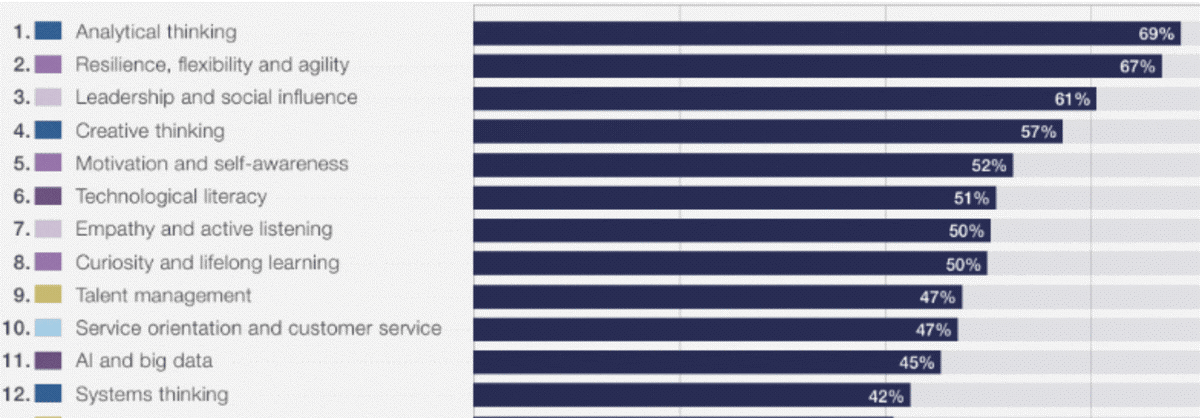
Top core skills in 2025, according to World Economic Forum Future of Jobs Report survey (page 35, figure 3.3).
“The Aptitude That Matters”
The WEF found that the “most prominent skills differentiating growing from declining jobs are anticipated to comprise resilience; flexibility and agility; resource management and operations; quality control; programming and technological literacy.”
Agility is a byword. Executive coach Liz Tran contributed a CNBC article on Agility Quotient, “the new ‘non-negotiable’ skill of highly successful people.” Tran’s book, “AQ: A New Kind of Intelligence for a World That’s Always Changing,” defines it as “the ability to handle change, uncertainty, and the unknown.”
“In a world where stability is a myth, AQ is the aptitude that matters.”
Workplace experts have been encouraging employers to drop college degree requirements in order to cast a wider net. Some have taken the advice, as have government agencies, but not to the extent proponents had hoped for.
As offered in the Deloitte report, “Start with skills that are mission-critical today and in the near future,” rather than try to create “an exhaustive skills inventory.” It also recommended, “Meet the business where it is: processes, tools and people will look different for different functions;” and “when redesigning work, take a data-driven approach but rely on people for the creative reinvention.”
Cross-Functional Bridges
An article this year in Harvard Business Review highlighted Mastercard’s internal talent program, Unlocked, which retired chief people officer Michael Fraccaro elaborated on: “It’s an employee-led platform where people get matched to different types of opportunities – such as projects, mentorship, volunteering, and open roles – based on the skills they have and the ones they want to acquire or develop . . .
“We are performing above benchmark standards, with more than 90% of our employees registered and more than 40% engaging with the platform monthly,” he shared. “Fifty-seven percent of project assignments are cross-functional, which helps us build bridges across the business.”
“If we don’t provide these opportunities internally, we risk losing talent,” he warned.
“We have to take a very serious look at what is happening in the labor market,” the IMF’s Georgieva urged. “What can we do? The answer is . . . we have to help people to enhance their skills.”
L.A. Winokur is a veteran business journalist based in the San Francisco Bay Area.
Topics: Career Development, Career Trends, Enterprise, Tools & Techniques