
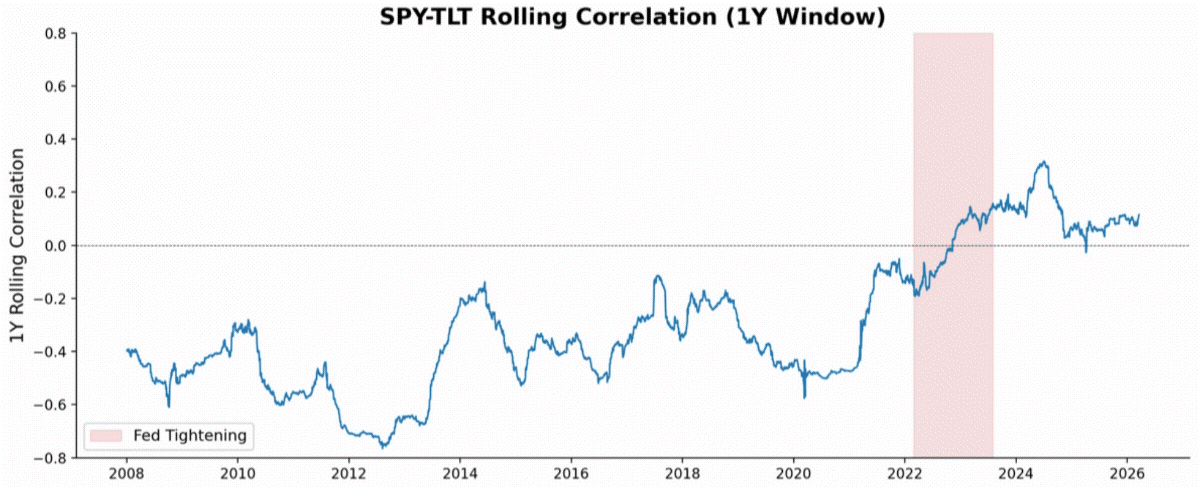
For two decades, institutional portfolio construction rested on a simple assumption: when equities fell, Treasuries would rally. The 60/40 portfolio, risk parity strategies and virtually every asset-allocation framework were built on that negative stock–bond correlation. In 2022, as inflation surged and the Federal Reserve tightened policy aggressively, that assumption collapsed: both bonds and equities fell together. Diversification evaporated precisely when it was needed most.
Figure 1 - Correlation between SP500 and Treasury Bonds
Recently, investors trying to find diversification or performance through safe havens due to conflicts in Iran and the oil surge, such as gold (or silver, which is not truly a safe haven but is highly correlated with gold), were also surprised. The same issue arises with currencies that used to be pegged.
Correlation measures co-movement, not mechanism. It describes that two variables move together, but not why. When underlying drivers change, and they do during regime shifts, policy pivots or crises, correlation-based models can fail exactly when practitioners need them most.
This article is an introduction to how large language models (LLMs) can solve those issues.
Beyond Sentiment: From Moves to Mechanisms
A natural question is: When an asset posts an extreme return, what caused it? Modern LLMs make it possible to process huge volumes of unstructured information, such as news articles, filings and policy statements to seek an answer. The goal is to automatically map each significant price move to a plausible explanatory event. Over time, these events and their market impacts can be organized into a directed acyclic graph (DAG) of cause-effect relationships.
Mathieu Tancrez
This approach goes well beyond traditional sentiment analysis. For example, Dogu Araci’s FinBERT model fine-tunes BERT on financial text to classify news as positive or negative. Such sentiment models improve on generic NLP tools, but they only capture tone, not causal mechanism. Two assets might react oppositely to the same news headline for entirely different reasons, yet a sentiment score alone cannot reveal that.
By contrast, an LLM can digest a news article and extract a structured causal hypothesis, identifying transmission channels, timing and expected magnitude for each affected asset. In other words, the mechanism itself becomes the signal, not the sentiment. The same news may produce different predictions and reasoning chains across assets, depending on each asset’s exposure. In practice, LLMs have been used to filter “noise” in financial text. For example, Shuqi Li et al. propose a “denoised news encoder” using LLMs to sift through massive news volumes and extract useful signals.
From Hypothesis to Validation
The core of this framework is a causal inference pipeline that combines LLM-generated hypotheses with rigorous statistical tests. In practice, LLMs are used to parse news, filings and even prediction market data, and extract structured “events”. Each event is transformed into a candidate causal link: which assets moved, in what direction, and via what channel. Crucially, the LLM’s output is treated as a hypothesis, never a conclusion.
Each proposed link is then tested by statistical methods. For example, multi-factor event studies (using Fama–French 5 factors) measure whether an event produced a significant abnormal return on the predicted asset. Cross-correlation analysis identifies time lags and the speed of transmission between markets. Granger causality tests check whether the event type consistently precedes and predicts asset returns. Local projection impulse-response models estimate how the effect unfolds over different horizons. Together, these tools cover both point-in-time impact and persistence. (This multi-test approach is similar in spirit to that of Ivan Letteri, who combines Granger and other causality tests in a staged pipeline.)
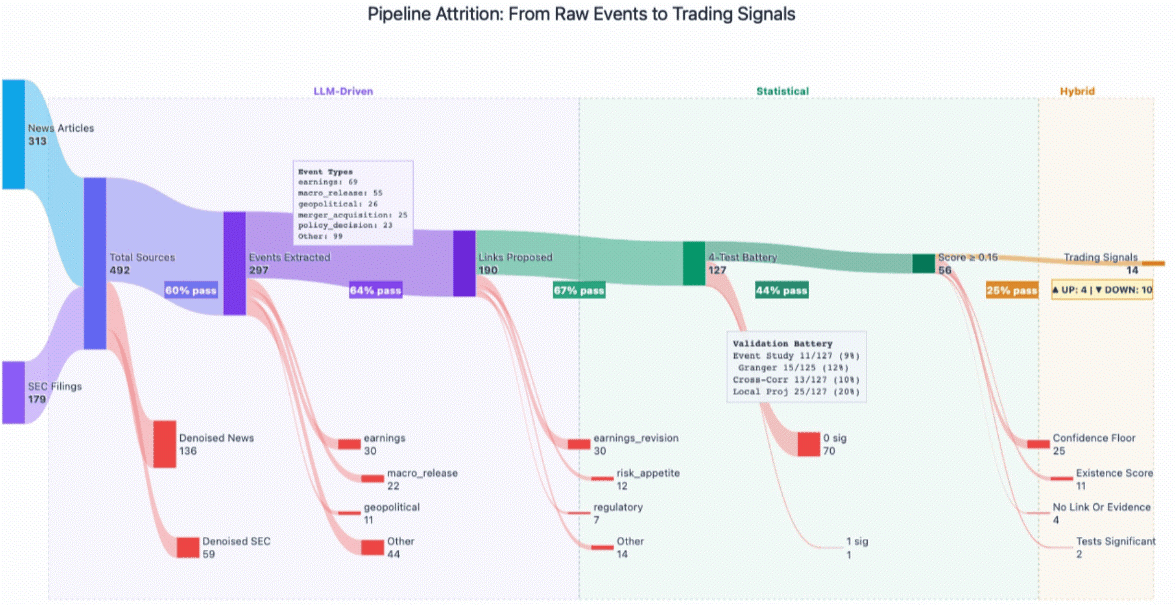
Figure 2 - Sources to Signals
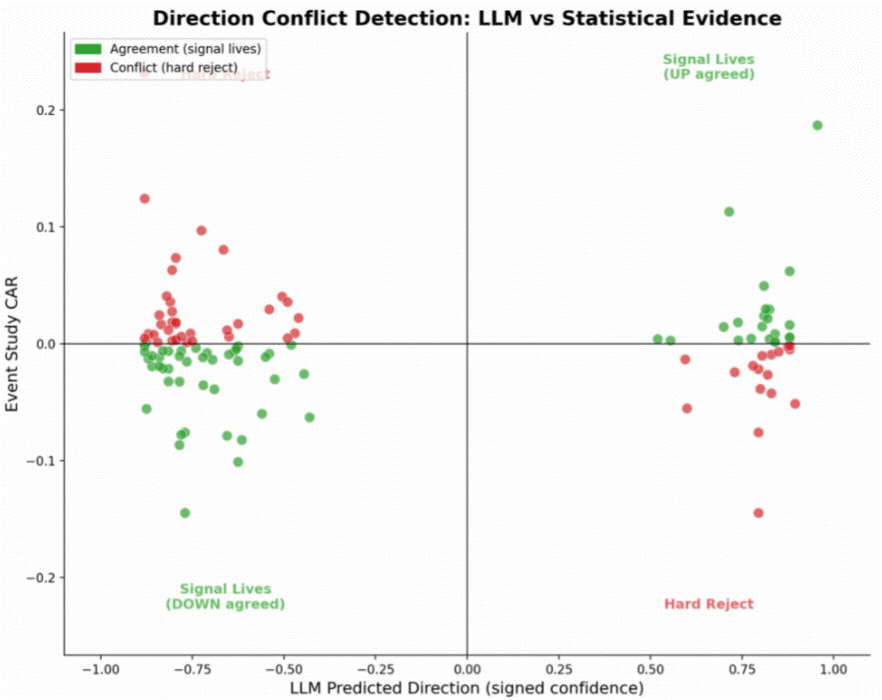
A final confidence score blends the LLM’s reasoning with the statistical evidence (we chose to weight narrative and data equally). Quality gates reject any signal that lacks minimum statistical support. In particular, a hard rejection rule enforces data primacy: if the statistical event study shows the price moving opposite to the LLM’s forecast, the signal is discarded regardless of the narrative’s appeal. Earlier designs averaged conflicting signals, often diluting strong effects. In contrast, insisting that story and data align (as in Letteri’s pipeline) produces clearer signals.
In summary, the LLM proposes mechanisms that statistics alone could not formulate; the statistics catch spurious or unsupported hypotheses that the LLM might produce.
The empirical results illustrate the approach. In our case study, the pipeline extracted 297 structured events from 313 news articles and 179 Securities and Exchange Commission filings. It proposed 190 causal links and validated 127 of them through four independent statistical tests. Additionally, the pipeline generated 14 trading signals across 28 assets spanning equities, commodities, currencies and crypto, using daily, hourly and five-minute intraday data.
A fast model (Gemini-3-flash) handled event extraction, while a larger reasoning model (Gemini-3.1-Pro) handled causal analysis, signal scoring and reporting.
What This Means for Risk Management
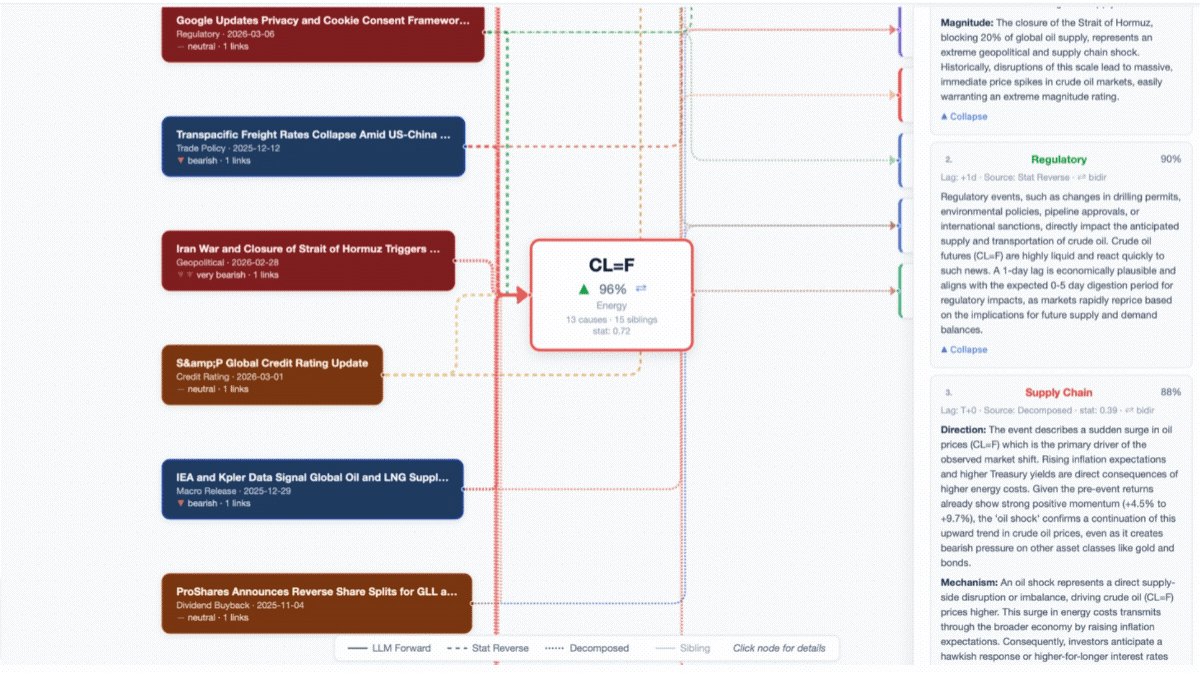
Once validated, the causal links form a network: assets are nodes and transmission channels are directed edges, with weights encoding strength and speed of impact. This network provides a dynamic view of market risk. It highlights which assets tend to transmit shocks, which absorb them, and which amplify them.
Changes in this network can signal regime shifts. New edges forming, existing links strengthening, or transmission lags shortening may indicate that underlying market dynamics are evolving. In effect, contagion becomes detectable early, as the structure of the network shifts.
Figure 3 - Causal Transmission DAG
The same framework supports forward-looking stress testing. Instead of replaying historical episodes, one can introduce a hypothetical shock (for example, a 100-basis-point emergency rate hike) and propagate it through the network’s causal channels. Because the relationships are mechanism-based, this generates coherent scenarios even if they have never occurred before. Moreover, a causal model can capture crisis-specific dynamics: under stress, additional channels (margin calls, forced liquidations, counterparty risk) can activate connections that sit dormant in normal times. The result is a richer set of scenarios – forward simulations based on underlying logic, rather than past analogues based on correlations.
Limitations and Challenges
This framework is powerful but not foolproof. LLMs, in particular, exhibit systematic biases. For example, they often have a built-in bullish skew, predicting price increases more often than declines, despite a neutral instruction. Fortunately, the output format (with separate direction and confidence fields) makes this bias visible, and it can be corrected by calibration.
The most costly failure mode is a direct conflict between narrative and data. When the LLM predicts a move opposite to what the event study shows, the system must choose. We find that hard rejection of the narrative (trusting the data) is more robust than averaging or hedging between them.
Figure 4 - Conflict between Narrative and Data
Another risk is mechanism “hallucination.” LLMs can invent plausible-sounding causal chains. Statistical validation filters out many of these, but it cannot catch a false mechanism that happens to align with the data by chance. Stringent confidence thresholds and multiple tests help, but practitioners should remain alert to this possibility.
Data requirements are another constraint. Event studies typically need a substantial estimation window (on the order of 250 trading days) to be reliable. For very new assets or event types, the necessary history may not exist. Moreover, running multiple tests across many hypotheses raises the risk of false discoveries. Standard corrections (Bonferroni etc.) can be too conservative, potentially eliminating genuine signals along with noise. These are active research challenges in quantitative risk.
Looking Forward
Sentiment analysis told practitioners what the market felt. A causal-inference framework aims to tell them what the market is thinking and then checks if it is right. Combining LLMs with statistical rigor creates a more resilient approach than either alone. LLMs detect mechanisms and generate hypotheses from complex inputs; statistical tests enforce discipline and guard against spurious claims.
For risk managers, the shift from correlation to causation is not academic. It determines whether risk models will hold in the next regime change, when relationships thought to be permanent are revealed to be contingent. A mechanism-based view provides a more solid foundation, especially in turbulent times.
Going Further
Once the initial DAG is built, it can be iterated and enriched. Each node (event) and edge (causal link) can be updated with new data, alternative models or external information. For example, additional web searches or specialized analytics could refine the estimated impact of a given link. This makes the system adaptive: as new information arrives, the network evolves.
Over time, such a framework may enable risk systems that respond not just to changing correlations, but to changing causes. By focusing on why markets move, not just that they move together, practitioners can build risk models that survive the next big shock – and the one after that.
Mathieu Tancrez is a senior quantitative risk professional and founder of StressGen, an AI-augmented stress testing engine. The GenAI causal inference framework presented in this article is one of those layers.
Topics: Modeling, Investment Management, Innovation