
Last month I explored how great risk managers must think tragically to fulfill their analytical obligations to an organization. Expanding on this theme, this article shifts focus to the CEO, moving beyond analysis to the burden of decision-making.
Today, the concept of truth often feels like a relic of a simpler age. We operate in a post-truth landscape defined by algorithmic polarization, deepfakes, and the comfort of echo chambers. For the CEO, this environment is lethal. If the Chief Risk Officer (CRO) is tasked with the tragically rational task of risk analysis, then the CEO is tasked with the Dionysian burden of the decision itself.
Risk analysis and decision-making are frequently conflated, but they are distinct disciplines. Analysis is the map; decision-making is the direction.
To navigate successfully, a CEO must possess more than just data; she must possess a tragic mind. As Robert Kaplan notes in The Tragic Mind, tragedy is not about failure, but about a loss of illusion. It is the basis of self-awareness and the development of true individuality.
The ancient Greeks understood the concept of truth as unforgetting. In a world that encourages us to forget our limitations, the tragic leader remembers them, and in doing so, finds the power to act.
Risk Analysis and the Architecture of Tragic Decision-Making
If the CRO provides the ground-truth risk analysis, the CEO must integrate that truth into the organization’s character through the lens of risk appetite. This is where the theoretical meets the practical.
Brenda Boultwood
We think of risk appetite as the amount and type of risk an organization is willing to pursue or retain. Through a tragic lens, risk appetite is the formal recognition of constraints. Kaplan observes that true tragedy is characterized by a searing awareness of the narrow choices we face even in a vast landscape.
A CEO who lacks a tragic mind views risk appetite as a speed limit to be negotiated or bypassed by ambition. A CEO with a tragic mind views it as the tragically rational boundary that protects the firm from Dionysian chaos. To think tragically is to be aware of all of one’s limitations, including financial, operational, and moral, to allow the organization to act more effectively within the space that remains.
Once this risk appetite is understood, it is not the data that makes the final call, but the leader's character.
Paradoxes of Tragic Decision-Making
The transition from analysis to action is fraught with three primary paradoxes that every CEO must navigate:
1. Authority and constraint. A CEO appears to have absolute authority. Yet the tragic mind reveals that the higher one climbs, the more awful and constrained the choices become. Like Sophocles’ Antigone, leaders often find themselves in situations where there is no clean way out and where every path carries a cost. The tragic leader accepts this burden rather than delegating it to a risk model.
2. Ambition and fear. Human ambition is the engine of corporate growth, but uncurbed ambition begs for a tragic outcome. We escape the trap of destructive ambition through a healthy fear of bad outcomes. This is not the paralyzing fear of the timid, but the constructive fear that keeps a leader rooted in unforgetfulness, or Aletheia. They do not forget where they came from or the fragility of their success.
3. Active silence. Whether a leader acts or refuses to act, a decision has been made. The decision to remain quiet in the face of a breach in risk appetite is a Dionysian act of chaos. The tragic mind recognizes that not acting is a heavy, consequential choice that demands the same level of individual accountability as a bold acquisition.
Aletheia vs. the Post-Truth CEO
Tragedy is critical to the development of individuality because it strips away the collective delusions of the crowd.
In a post-truth world, the CEO is under constant pressure to prioritize optics over reality. However, the rebel leader, a Promethean figure who fights for a better world, is not a liar. Prometheus was a rebel because he saw a truth that others ignored and acted upon it despite the personal cost. It is leadership at a crossroads, as depicted in this figure:
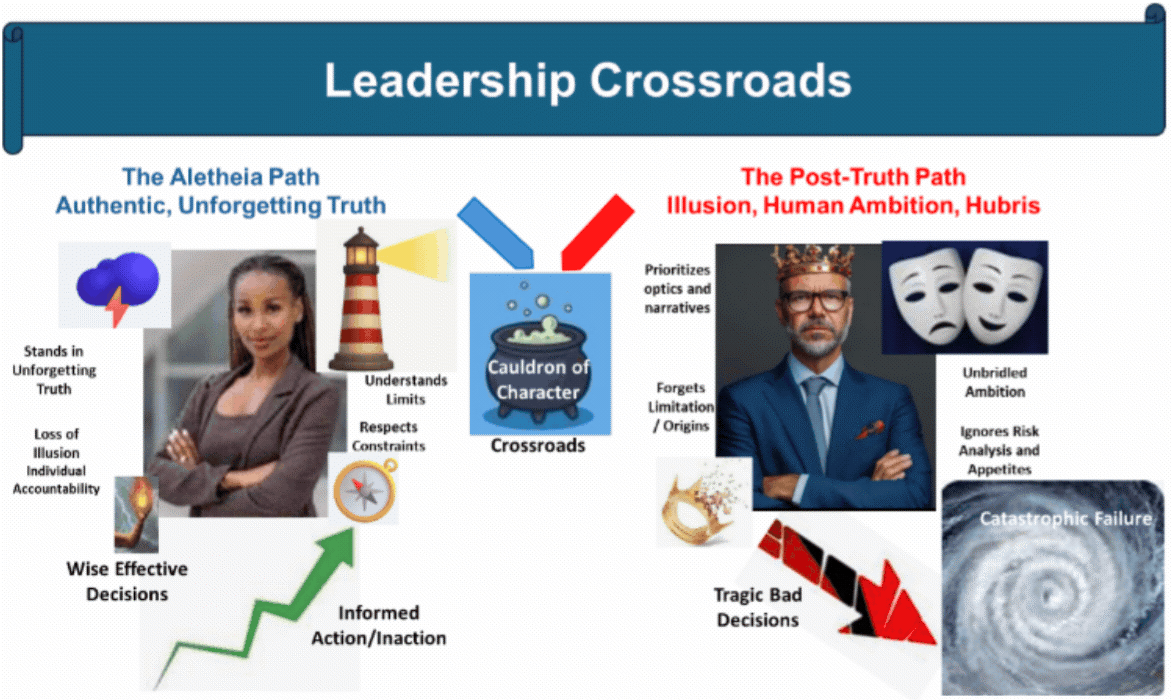
The Aletheia leader embodies the tragic mindset. This leader embodies individual accountability and loss of illusion to respects for constraints and risk appetite, the formal recognition of limitations. The central symbol, a lighthouse, guides the Aletheia truth and leads directly to the ultimate goal of wise, effective decisions and deliberate actions and inactions.
On the image’s right side is our all-too-familiar, post-truth alternative. This leader begins with prioritizing optics and narrative in an echo chamber of sycophants and bias. This path emphasizes how easily limitations and origins are forgotten, and unbridled ambition leads to the ultimate hubris.
This leadership style is dangerous for any organization. The arrow points downwards into a chaotic spiral where catastrophic failure and tragic bad decisions are inevitable.
Character in the Crucible: Current Events
The 2023 regional banking crisis remains a definitive example of the difference between risk analysis and decision-making. The analysis of interest rate risk was available to many. The decision to ignore the narrowing constraints of liquidity was a failure of character and tragic thinking. The leaders who survived were those who practiced anxious foresight. They understood that their authority did not grant them immunity from the laws of duration risk.
In the burgeoning field of generative AI, we see another Promethean moment. The rebel leaders in this space are not those whose investments are driven by FOMO (fear of missing out), but those who are informed by good risk analysis. They recognize the cruelty of potential outcomes, bias, job displacement, rapid adjustment leading to instability, and they fight to create a better world by setting rigorous boundaries before the tragedy occurs.
They are fighting for an outcome where the Dionysian power of AI is harnessed within a tragically rational framework of regulations and restrained product release.
Parting Thoughts
We live in an age that rewards the illusion of infinite growth and the evasion of hard truths. But as Sophocles and Euripides taught us, the wildly irrational factors of human experience cannot be ignored forever.
Leadership character maximizes organizational strengths by confronting the tragic truth of acknowledged boundaries. Limited options dictate the available paths. A healthy fear of the abyss tempers ambition, regardless of the peril’s origin.
The CEO should not merely want the truth. The CEO must crave it, especially when it is tragic. To be a rebel leader like Prometheus is to accept the chains of responsibility in exchange for the fire of progress.
By linking character to Aletheia and decision-making to a clear organizational risk appetite, the modern CEO can escape the gravity of post-truth convenience. In the end, the most tragically rational decision a leader can make is to acknowledge the Dionysian madness around them and choose to stand, unforgetting and accountable, in the truth.
Brenda Boultwood is the Distinguished Visiting Professor, Admiral Crowe Chair, in the Economics Department at the United States Naval Academy. The views expressed in this article are her own and should not be attributed to the United States Naval Academy or the U.S. Department of Defense.
She is the former Director of the Office of Risk Management at the International Monetary Fund. She has previously served as a board member at both the Committee of Chief Risk Officers (CCRO) and GARP, and is also the former senior vice president and chief risk officer at Constellation Energy. She held a variety of business, risk management, and compliance roles at JPMorgan Chase and Bank One.
Topics: Enterprise