
In 1935 physicist Erwin Schrödinger discussed in correspondence with Albert Einstein his now famous thought experiment illustrating quantum superposition. “Schrödinger’s cat” is closed up in a box and linked to a random quantum event. For an outside observer, this cat, according to Schrödinger, is both dead and alive, or in “superposition,” meaning it can have two states at the same time, until the observer opens the box, forcing a single outcome, alive or dead.
In the same way that Schrödinger wanted to move the implications of the quantum state to the much larger, observable world, we can move this phenomenon to the world of financial risk management, and especially the default. Is it possible that the default property isn’t a binary characteristic after all, but exists in a more fuzzy state?
The Binary Default Characteristic
A more fuzzy default definition would have large consequences. PD (probability of default) is based upon the modeling of a binary property – a loan is in default, yes or no. For our forward projections, we attach probabilities, because we are uncertain if a loan will default in the upcoming year. Hence we speak of the probability of default. But the historical realizations are for sure binary, and this property is heavily exploited in all credit risk modeling activities.
PD models are traditionally based upon binary classification models such as discriminant and logistic regression. More modern approaches use machine learning (ML), but these are still divided across regression models (that model a continuous dependent variable) and classification models (for binary dependent variables).
These statistical PD models are estimated with the help of historical datasets that contain default indicators (represented by yes/no, or 1/0 indicator values). Databases and operational systems have been implemented in which the default indicator is set to a binary value (a “Boolean”), thereby fixing this property in the data collections and preparing it for use in classification models.
Marco Folpmers
Further risk parameters are building upon this framework of a binary classifier. Loss given default (LGD) models work with the recovery values that have been realized for the subset of historical defaults; the binary default indicator is needed to make this subset. The EAD (exposure at default) parameter works in such a way that it can be multiplied by PD and LGD in order to deliver a meaningful expected loss amount and thereby “inherits” its dependence upon the binary classifier for default.
Forward propagation of this dependency moves towards the capital requirements and IFRS 9 Expected Credit Loss. And the less-regulated credit risk models are affected by the same dependency: Pricing models for credit risk, economic capital, early warning indicators, all ultimately rest upon the binary classifier of the default property.
How Does the Fuzzy State Look?
Whereas one can think of future default probabilities, it is uncommon to regard a current snapshot as containing “in-between” cases. This would look like the graph in Figure 1.
Figure 1
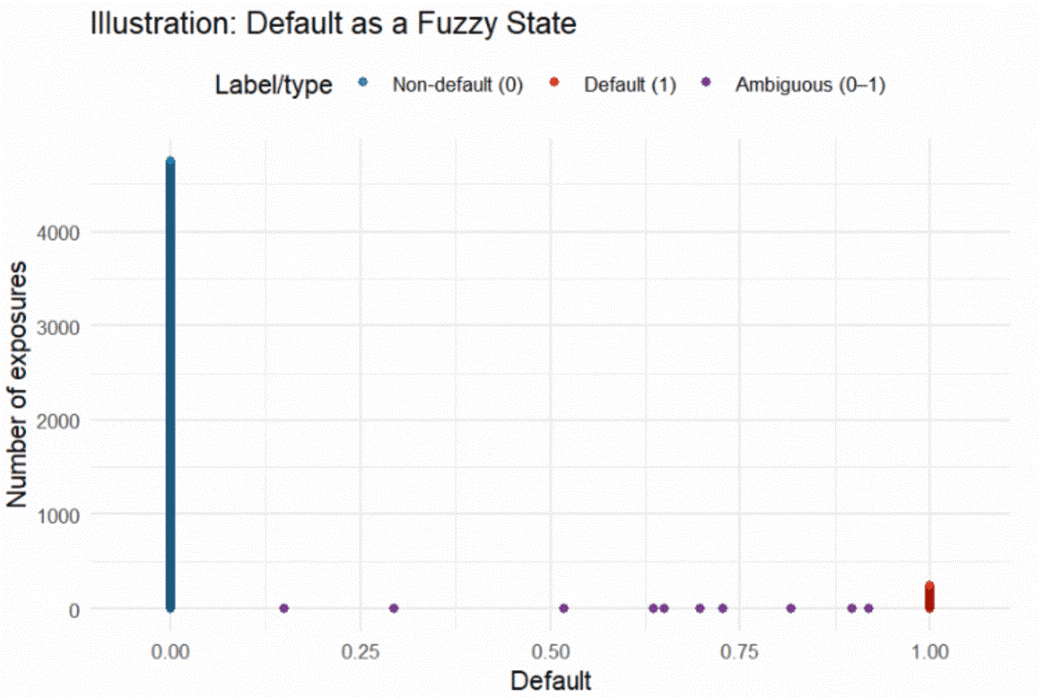
Suppose that we have a portfolio of 5,000 exposures. Of these, 95% are certainly performing. They have a default indicator of 0.
Then we have defaults. Instead of making up the remaining 5% of the pool, they make up 4.8%. We don’t know if the remaining 0.2% are in default, yes or no. We can guess at it and attach a probability, as has been done for the 10 exposures that are in this “intermediate state,” as illustrated by the purple circles above.
We can provide some examples of this “in-between” state.
Suppose that we have a number of exposures that have been in arrears for 89 days, as measured by our operational and risk systems. At the moment we are unsure if the arrears have continued up to the 90th day, which is the cut-off point for the days-past-due (DPD) criterion for a default. We simply don’t know.
This can have to do with administrative systems that are not fully current with DPD counting, or that consist of multiple interfaces through which the information needs to pass before it reaches us. It can also have to do with failing systems due to IT glitches or downtime. Or expert overrides that need to take place. All we know is that the exposure had 89 days past due the last time we checked, but where it stands now, we cannot say precisely. All we can say as risk professionals is that if it was 89 DPD yesterday, today it is likely that it has defaulted, and attach a probability of, say, 90% to that outcome.
We mentioned already expert overrides. This is a typical interplay between system information and human involvement, and could hence easily introduce further fuzziness. How about system-triggered defaults that still need to be vetted by experts? Or, vice versa, performing loans that may be given a default state due to an expert override?
Further fuzziness is introduced by complex rules around the default indicator. Notorious examples are reversal of the default indicator through cure, the probation period (the minimum time the exposure needs to be “clean,” before it may revert to a healthy status, typically between 6 and 12 months); and the dependence or “re-default linkage” period, i.e. the clustering of re-defaults into a single default (typically if a defaulted loan cures and redefaults within 12 to 24 months, it is counted as the same default).
These tend to be highly complex business rules that need to be developed and implemented in IT systems. For those that are skeptical about the fuzziness of the default indicator, I can also reverse the case: Can you be 100% certain that these complex business rules around expert overrides, probation and dependence have been properly developed and implemented? If one is not sure for the full 100%, one has to conclude that the default indicator is more complex than only a zero/one property, and can only admit that it is fuzzy indeed.
Label Noise
If accepting the fuzziness of the historical default indicator, what can we do? I think the first leap of thought is that one is to accept, not only for future realizations but also for historical and current databases, that the default property is not always as clear-cut as one tends to believe. It is not so robustly binary as the database and statistical models assume it to be.
The next step is that this phenomenon of “label noise” is investigated. How certain are we of the historical allocation of exposures to default and non-default? What are typical root causes of “borderline” cases? Are these borderline cases then a negligible part of the total dataset, or maybe less negligible so that we cannot simply ignore them? In that case, specific action is needed to remediate the underlying processes and systems so that we arrive at a more robust default indicator. During that journey, one might even consider to add a specific margin of conservatism to the PD outcomes that are used for the calculation of the IRB (internal ratings-based) capital requirement.
If one prefers to attack the issue with the help of statistical models, one could have a look at the expectation-maximization (EM) algorithm that, applied to credit risk modeling, distinguishes between an unobserved true default flag and an observed noisy flag. I think it is fair to say that these EM add-ons have so far not been widely applied by financial risk modelers.
Both Dead and Alive
The Schrödinger cat illustrates how the unthinkable becomes true: The cat is both dead and alive.
For FRM professionals, the canonical default property can be seen in a similar light. It is then good to realize that reality can be unsettling at times, and that the default status is less clear-cut than one would hope for.
Dr. Marco Folpmers (FRM) is a partner for Financial Risk Management at Deloitte the Netherlands.